Showing posts with label Fr. Alan Jurkus. Show all posts

Jurkus on clerical celibacy for the long term

Fr. Alan F. Jurkus is among the Milwaukee Archdiocese's 2014 priests to retire from active ministry, reports the Milwaukee Catholic Herald. That also meant that he recently retired as pastor of our parish (St. Alphonsus, Greendale).

Looking back on what he's said over the years, what was his most notable insight? It's in this article, titled Priest Recruiters Happier, from The Milwaukee Journal, October 15, 1977, when he was vocations director for the Milwaukee Archdiocese.

"'A short term solution to the vocations problem would be to do away with mandatory celibacy,' Jurkus said. 'But it would be short term.'"
It's hard to evaluate this against a counterfactual; it's not as if half the dioceses changed the celibacy rule, the other half didn't, and we compare results. But to get some indication of the effect of permitting married Catholic clergy, we can look at permanent deacons.

A Portrait of the Permanent Diaconate:A Study for the U.S. Conference of Catholic Bishops 2012-2013 reported the Age of Active Deacons (p. 11) as follows:
1% 39 or less;
6% 40-49;
26%50-59;
43% 60-69;
25% 70 or older.
Even considering that "the minimum age for ordination to the permanent diaconate is 35", it's striking that twice as many deacons were over 59 as under 60. That supports Fr. Jurkus prediction of only a short term effect.

While I don't have statistics for the "Womenpriests", everyone in the reports of "ordinations" I recall reading has been at least as old as I am. The biographical and photographic evidence at the Roman Catholic WomenPriests website is generally consistent with this.

So it looks like Fr. Jurkus was probably right almost 40 years ago that an end to mandatory celibacy would not have made much difference over the long term.

Goofy

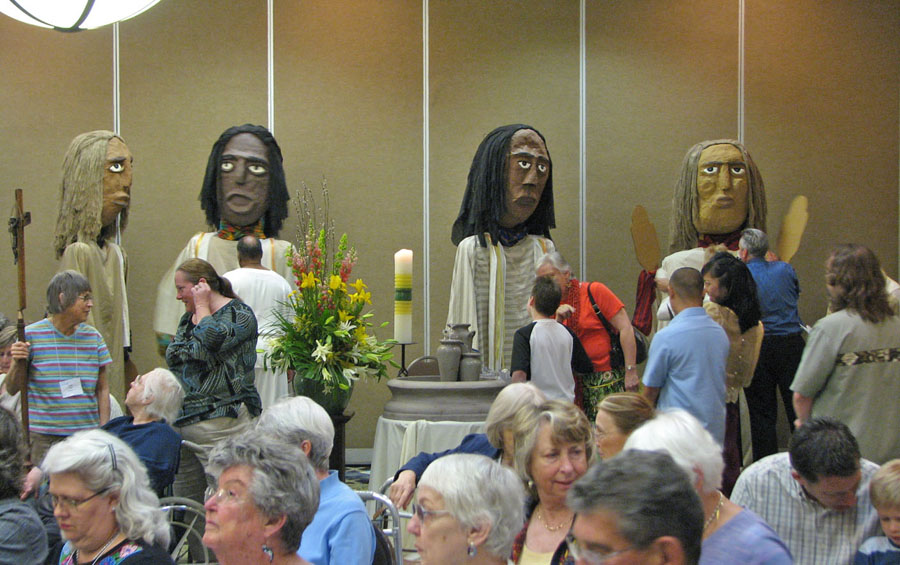
The processional at the start of Mass at St. Alphonsus Church on Sunday morning was a bit unusual.

In addition to the cross and Bible held high, a tool belt and firefighter's helmet were carried out before the altar by congregants grateful to have a church.

Above the doors were banners that said "Welcome Home."

"It's just like the sign says - it's like coming home again," Betty Richard, a church member for 35 years, said shortly before she solemnly carried a Greendale Fire Department helmet in front of hundreds of parishioners at Sunday's 9 a.m. Mass.

The exultation of the firefighter's helmet and tool belt were apt: If not for the valiant efforts by fire crews and the hard work of construction workers, the reopening of one of the largest Catholic churches in the Milwaukee area might have taken much longer.

While the sanctuary and nave on W. Loomis Road were gutted and rebuilt after a Christmas Eve blaze that damaged the church and school, parishioners attended services in a community room and sat on folding chairs. Father Alan Jurkus, whose words were beamed to an overflow room via closed-circuit TV, compared the time to being in exile.

......

The first hymn sung at Mass was "All are Welcome," a song with a double meaning in the newly constructed house of worship:

"Let us build a house where love can dwell and all can safely live, a place where saints and children tell how hearts learn to forgive. Built of hopes and dreams and visions, rock of faith and vault of grace, here the love of Christ shall end divisions."
more at MkeJS

Back in the day, we used to pray for firefighters, not canonize them.

Jurkus, +Weakland, and "Psycho-Sexual Integration"


 From a reader:
I'm just sending you this email to provide you with new information on the endeavours of Spirit-of-Vatican-2-friendly priest Fr. Alan Jurkus.

I do not attend St. Alphonsus anymore (too many heresies given outright or implied acceptance, and liturgical abuses continue... ) but my family still attends there.  In the bulletin:

"Thanks to all who signed the nomination forms recommending the Religious Women as a group to receive this year’s Vatican II Award. We will see what the archdiocese decides.

I have a priests’ council meeting this Tuesday. This is always a worthwhile meeting since the Archbishop has the opportunity to hear the wisdom of the priests on issues of importance for the future of our local church. 
[Like married priests or bad translations?]

I will be gone June 11-14 to attend the first convocation of the United States Association of Catholic Priests. In just eight months, we have grown from a group of 24 “founding fathers” (I was happy to be among them) to over 600 members. About 200 priests will gather for this conference called Keeping the Spirit of Vatican II Alive.
 Yes, that is a real conference that grown ups are actually attending.

The Spirit Godfather, His Excellency Rembert Weakland will be speaking, along with ... some others....
Fr. Bob Cushing - “Our Sacred Wound: Contemplation and Psycho-Sexual Integration”
This focus session is a workshop on Contemplation and Psycho-Sexual Integration. The method is through peer spiritual direction where a group of 5 to 15 men are invited to treasure life stories in a safe and sacred space through contemplative listening and responding. This is an invitation to be the sanctuary where personal story-telling in triads will empower men to name and claim their own sexual history.
Speaking of causes for the sexual abuse scandal.....

ht JK

ProvEmails: Those who have ears, too, here

The suburban weekly Now newspaper reported on the Greendale Tall Corn Contest.

"For those looking for some divine intervention in their favor, [Anne Marie] Pelkofer has this 'tidbit' to add to the mix, courtesy of St. Alphonsus Catholic Church in Greendale.

"'Father Alan (Jurkus), who is the pastor at St. Alphonsus, stopped by today with holy water in a little Tupperware container, and he said if you plant (the corn) and then sprinkle holy water on it, it'll grow even bigger,' she said."
The Provincial Emails

Milwaukee priest advocates for married clergy

Father Alan Jurkus is back at it.
Time to consider married priests

As a priest of the Archdiocese of Milwaukee, I welcome Deacon Russ Arnett and his family and look forward to working with him after his ordination to the Catholic priesthood. He previously served as an Episcopal priest (Page 5B, Nov. 7).
I believe he will bring a special gift to our church as he is allowed to combine the two sacramental vocations of marriage and holy orders. This combination should be of great value to the work of the gospel.
At the same time, I regret that married baptized Catholics who wish to serve as priests are not afforded the same opportunity.
At a time when our church is in serious need of priests, it is my hope and prayer that the Holy Spirit will inspire a change in the current law and permit baptized married Catholics to serve as priests.
The Rev. A.F. Jurkus
Greenfield
JSOnline  This was from back on Nov 10th(see what happens when I get busy at work!).

Mr. Berres(a parishioner) had this to say: 
The reference to law presumably is meant to eliminate any potential ambiguity that might otherwise leave the impression he's advocating women's ordination while avoiding saying so explicitly.
Manufactured.Vocations.Crisis.  These are the same people that rejected orthodox candidates because they were not pastoral enough.  Read Good Bye, Good Men.  They wanted low numbers to "force" the Church to allow for women "priests."

I never get this line of thinking anyway.  If you want married clergy, there's plenty of Eastern Rite Catholic Churches around(especially in Milwaukee).  Oh, but then he'd have to suffer through a beautiful liturgy.  If you remember, he's not a fan.

Liturgical translations, what if we just said BOOYAH!

The Provincial Emails blog has more about a recent Mil Journal Sentinel article on the new translation.
In the Milwaukee Journal Sentinel article linked in this earlier post, our pastor mentions that he sent a letter to parishioners on the pending changes in the English translation of the Mass. Here is his letter.

Those changes and what lead up to them are also the subject of this Adoremus Bulletin article.

They differ on almost every point, even on history. Father Jurkus portrays a change in approach sprung in 1999 by "Pope John Paul II and, reportedly, a smaller group of Vatican experts...". The Adoremus article notes that "Pope John Paul had called for review and reform of the post-conciliar liturgy in his 1988 apostolic letter Vicesimus Quintus Annus." 
Here is the text the letter of Fr. Alan Jurkus(from the scanned copy above) with my commentary.
This Advent, all parishes in the USA will be asked to start an educational and formation program to prepare us for the implementation of the NEW[dare we say modern] translations, which will be used in our Masses starting Advent, 2011.

I thought a little history might be helpful.

The Vatican Council (1963-65) decreed that the spoken language of "the people" might[he admits that vernacular is optional] be used for celebrations of the Mass and the Sacraments.  This was a return to the ancient custom of the Church moving away from 500 years of using Latin, which ceased being the spoken language of the people centuries before. [The Roman Canon has not changed except for minor details for 1500 years.  I recommend Michael Davies - A Short History of the Roman Mass Perhaps Fr. Jurkus has heard the addage If it ain't broke, don't fix it?  He also ignores Latin's place in other places like the scientific community.  Perhaps biologists should translate all those silly names into something more modern, like Pig Latin.]

Pope Paul VI established a commission of international scholars for each language group in the world to translate the New Roman Missal from Latin into the SPOKEN language.[...since some of us WRITE in a different language than we SPEAK]  These commissions used a translation principal, which called for the translations to reflect the "SENSE" of the Latin rather than a slavishly literal translation.[That settles it.  Fr. Z is out of a job.  Curious he doesn't mention by who's instruction(and authority) the commission made that decision.]  This principle rooted in the Vatican Council [where?] and preferred among linguists provided us with several versions of the Mass prayers.[hmmm, apparently Mass prayers were too vague in the Latin to have so many different possible translations.]  Each time they were revised, they were a bit better. [rooted in Vatican Council = Spirit of Vatican Council]

Additionally, each English-speaking country was permitted to adapt the translations to their own particular vocabulary so that the Mass prayers would be readily understandable.  Just think how different English is in England than here.  [It's so incomprehensible it might as well be Greek! ........ or Latin!]

The Bishops of the USA approved another revised version of the Mass prayers in 1999, and it was sent to the Vatican for "confirmation," so it could be implemented. [... because the Vatican had no authority to quote confirm end quote?]

It was then that Pope[no quotes around Pope] John Paul II and, reportedly, a much smaller group of mostly Vatican experts[LOL!!  Only linguists can be scholars I guess.  In the Vatican it is the eeeeevil Experts] decided that all translations now would no longer be permitted to use the translation principle of "conveying the sense of the original" but would have to follow an exact and literal translation from the Latin.[But they are Linguists!  How could they error in judgment?!]  This was a tremendous change and was met with deep concern by many linguists and bishops.  Several attempts at dialogue[and a vote! What is this the Dark Ages?] to modify this requirement proved fruitless.  Work then began on preparing another translation to replace the unpublished 1999 version, this time following the demand for a literal translation.

As the years passed, a decreasing number of bishops continued to seek accommodation by seeking the possibility to use the "sense of the translation" principle or, at least, to adapt the literal translation to the "spoken" language forms suitable for each English-speaking country. [What do the young bishops think on this matter that differs from the old bishops?]

Finally, this year, despite objections of a small remnant of bishops who fought valiantly for some compromise[...Do you think giant puppets were involved?  Or maybe this was a more solemn occasion.], the final version was sent to the Vatican for "confirmation," which is expected this summer.

So, where does this leave us?  As this Advent begins, we will share the new translations and spend significant time and money to help us make this transition. [You could always just use the existing Latin that is available to you]

Many fear that this translation will result in a "church" English or a translation not in harmony with our spoken language or sound stilted. [Children will no longer need ghost stories with this linguistic monster lurking in the shadows]

In spite of these concerns, this can be a good time for us to re-examine the deeper aspects of our Mass and how we celebrate it and why we celebrate it and why we do and say what we do.  This can be a time of deepened appreciation and growth in understanding which, hopefully, will lead to a deeper spirituality.  I hope that we will take advantage of this opportunity to do so.[Father does wrap this up nicely I must say]

As Advent comes closer, we will share more information.

-Fr. Alan
 If going to English is this bad, why not just go strait to the Latin?

Milwaukee priests hate accurate translation, hoping to put it to a vote

Catholic clergy and lay leaders from around the region will gather in Milwaukee Thursday for a two-day conference that will be, for some, their first in-depth look at the controversial changes ahead in the Catholic liturgy.

The Vatican is issuing its most significant and extensive revision of the Roman Missal - the prayers and texts used in Catholic worship - since the 1960s in an effort said to better reflect the original Latin texts.

But some see the changes, due to be implemented late next year, as unwieldy and unnecessary. And they fear they could further alienate the faithful at a time when the church is already struggling financially and failing to retain members. [... the translation is done and it doesn't cost anything]

"For some people this will be very unsettling," said Father Ken Smits, a Capuchin priest and liturgical scholar[LOL]who is troubled by the move away from the vernacular to a more stilted, "sacralizing" language.

"The real concern is among the parish priests, who will have to explain something many of them are not in favor of," said Smits. "They'd much rather spend their time in ministry [because there's something more important than the Holy Sacrifice of the Mass] than have to go through this linguistic exercise."

The Archdiocese of Milwaukee workshop is one of 22 around the country aimed at educating clergy and lay leaders on the revisions.

Dean Daniels, director of the archdiocese's Office for Worship, called critics' concerns valid, but said the revision will bring English-speaking Catholics in line with the global church.

"Anytime there are changes, people go through the process of being angry and sad," [Hmmmm, that's not what the 1960s crowd said...] he said. "But the church has been changing forever. It's a dynamic, living organism."

The Vatican approved the U.S. version of the Missal revision in March. An international petition drive asking English-speaking bishops to slow the implementation using a pilot program has drawn more than 21,000 signatures, including many from Wisconsin. [.. non servium?]

The new translation, nine years in the making, is the work of the Vatican's Congregation for Divine Worship and Discipline of the Sacraments and a committee of English-speaking bishops and consultants known as Vox Clara, or "Clear Voice."

That alone is troubling to some who see the revisions as part of a systematic dismantling of provisions of the Second Vatican Council, which, among other things, endorsed the celebration of the Mass in the vernacular of the people and gave national bishops conferences authority over translations. [.... authority over the pope? ]

"The fathers of Vatican II said overwhelmingly that we know how to adapt the prayers to our own needs," said Father David Cooper of St. Matthias Parish in Milwaukee and chairman of the Milwaukee Archdiocese Priest Alliance. [Funny, I thought we might want to look at the documents themselves rather than taking someones word for it]

The new translation introduces more formal, rarefied language into the liturgy. But Cooper and others who have studied drafts say it ignores English grammar and syntax and introduces terms - "consubstantial," "oblation," "ignominy," to mention a few - unfamiliar to many American Catholics. And some [liberals] worry it will sow division in the pews. [from the original sowers of this division.  They just cant seem to stomp out the faithful like they had hoped.]

"You can call it whatever you like, but it's not English," said Cooper. [LOL!]

"The language of prayer is supposed to be evocative, graceful, uplifting,"[LOL, it feels good man, just do it!  It doesn't matter what we say, just how we FEEL] he said. "This reads like clunk-clunk-clunk-bang-boom." [The liturgical engine of old has been restarted to save the world]

Some pastors have already begun preparing their parishioners for the changes, which will ultimately require an investment in new missals and hymnals.

"Much of the music that has come up over the last 30 years will no longer be useable," said Father Alan Jurkus of St. Alphonsus Parish in Greendale, who sent out a letter this month notifying members of the coming changes. [THANKS BE TO GOD!!!!!]

Jurkus is encouraging parishioners to accept the revision as an opportunity to grow in their faith. But he harbors his own concerns.

"The bottom line for me is why. Why, with everything else that's going on in the church, do we have to rub salt in the wounds?" [Because liturgical accuracy causes pedophilia...]
 JSOnline

MJS is not stupid(as the article might indicate), they write these articles this way because controversy sells.   The translation is here and there's nothing the liturgical hippies can do about it.