Background:
St Brigid of Kildare would "like to give a lake of beer to God"
HT AS
continue at ryanscheelAmong all of the world’s religions, and among all Christian traditions, we Catholics have traditionally had the healthiest relationship with alcohol. We are never overly Puritanical in shunning drink, and neither are we a mystery cult looking for transcendence in drunkenness. We are to give thanks to God for his gifts and treat them as such.
In the nascent Church, when St. Peter refutes claims that he is drunk (Acts 2:13-15) by declaring that it is only 9:00 in the morning (because the Apostles clearly had the good sense to wait until at least after lunch), you can begin to get a glimpse of the Catholic relationship with the liquid spirits. St. Paul tells St. Timothy to “stop drinking only water, but take a little wine” (1 Tim. 5:23) to help him with his frequent stomach troubles. Even Our Blessed Lord Himself states declares that even “The Son of Man came eating and drinking”. (Luke 7:34)
Single servings of alcohol may be going away at Green Bay liquor and convenience stores.continue at WBAY
Alderman Guy Zima is proposing to ban them over concerns about litter and panhandling.
Zima proposed the idea to Green Bay’s Protection and Welfare Committee Monday.
“Single cans of alcohol,” Zima said would be banned. “Beer, malt liquor, small bottles of whiskey, gin.”
Under the proposal, people wouldn’t be able to open up a cooler and grab a bottle or can anymore. Zima says it would help the community.
“It seems to cut down on the litter in the neighborhoods, the panhandling the police-related alcohol calls and cuts down on homeless crime,” said Zima.
The long reign of Reinheitsgebot, German’s beer purity law.continue at Forbes
Humans have brewed beer since the birth of civilization. But one group – the Germans – managed to change the trajectory of the world’s brewing landscape forever by enacting Reinheitsgebot, a law that is celebrating its 500th anniversary this Saturday.
Why is this law so important? It set strict “purity” standards that resulted in a rigid consistency that many German brewers still follow – and also use as a marketing tool to say to the world that their beers are the best.
But American craft brewers contend the law’s legacy is to blame for why Germans have lagged behind on innovation in recent decades. And now the U.S., once the butt of some off-colored jokes in the beer world, have a beer culture that the rest of the world envies. “In one sense, it drives innovation and creativity because you must do things without the shortcuts,” says Jim Koch, founder of Samuel Adams maker Boston Beer. “On the other hand, if you don’t allow yourself as a brewer to color outside those lines, you are missing out on one of the unique things of the brewer’s art.”
The Reinheitsgebot, also called the “German beer purity law,” was first ratified on April 23, 1516, and it is regarded by many as the world’s first consumer protection law. Imposed by Duke Wilhelm IV of Bavaria, it required beer could only contain four ingredients: water, hops, malted barely and yeast. The original law was only 130 words long. [Shorter than a papal encyclical, who knew!?]

It's #NationalBeerDay! Why try just one on a day like today?Join us tonight to celebrate Thirsty Thursday and 2 for 1 pints from 8pm - 10pm.
Posted by The Great Dane Pub & Brewing Company on Thursday, April 7, 2016
 |
| St. Bride- John Duncan |
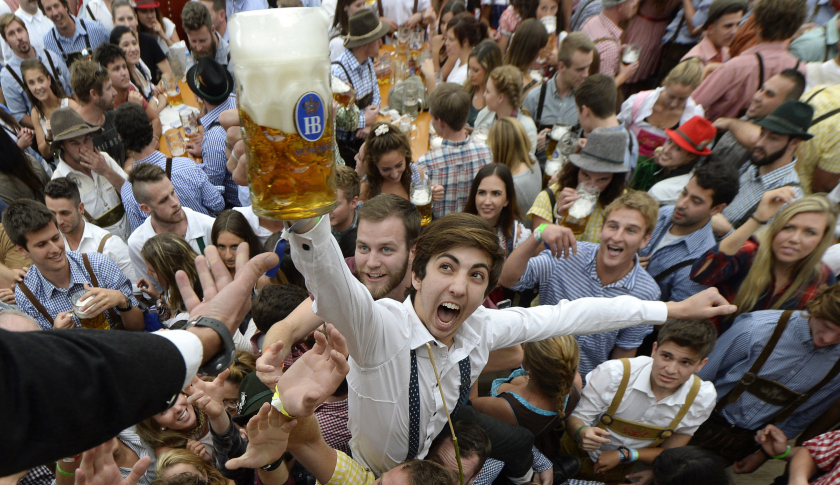
Welcome to October. The celebration of Oktoberfest is in full swing. Ever wondered where the party started?continue at The Compass
On Oct. 12, 1810, Bavaria’s crown prince Ludwig (late King Ludwig I) married Princess Therese of Saxony-Hildburghausen. Everyone in Munich was invited to attend festivities held in the fields outside the city. They liked it so well that they did it again the next year — and every year since. It soon became “Oktoberfest.”
Beer is a large part of Oktoberfest, but the frothy brew has church ties going back centuries before Ludwig and Therese ever met. (The royal Bavarian couple was Catholic, but Ludwig was not the best at following his marriage vows.)
Beer first appeared thousands of years ago, probably concocted by the Sumerians in the Middle East region of Mesopotamia. Ancient Egyptians also brewed beer, as did imperial Romans. But most of this early beer was not any sort of beer we would recognize today. Instead, it may have been made from barley while others could have been more like a Slavic drink known as kvass — low in alcohol content and brewed from stale bread. (This is probably part of the reason beer has often been called “liquid bread.”)
"'Tilt-a-Whirls, Cowbells and Beer,' a new documentary airing Monday on WMVS-TV (Channel 10)*, goes behind the scenes to show how Milwaukee church festivals come together, from bands to rides to food to beer.I wonder how singer-songwriter Pat McCurdy stacks up by that criterion.**
How much beer? A popular T-shirt sold at local church festivals reads 'Drinking for Jesus Summer Tour.'
"'The bands they have are based, really, on how much beer they (help) sell,' said Ron Faiola, the writer-director of 'Tilt-a-Whirls.'"
"Tilt-a-Whirls" is Greendale-based Faiola's latest look at Wisconsin culture. His first movie, 2009's 'Fish Fry Night Milwaukee,' explores the Friday obsession. 'Wisconsin Supper Clubs,' from 2011, was followed by a coffee-table book celebrating that dining tradition."Darned if those two previous documentaries aren't also on activities associated with having a drink or two.
*Air time 9pm.
**What might well be Mr. McCurdy's best-known composition, Sex and Beer, begins
"St. Paul in his letter to the Ephesians
Said, 'It came to me upon a midnight clear
I finished writing all of my gospel
Now all I seem to want is sex and beer'"

In the purchase and subsequent consumption of what’s playfully dubbed “Irish Holy Water,” fans of Finnegans beer are feeding the hungry in Minnesota, which has included clients of Catholic Charities in the past.
Since its beginning 15 years ago, the Minneapolis-based beer company has centered its business model on the common good, contributing 100 percent of its profits to alleviate hunger.
Finnegans’ formula is simple: It starts with “good beer” found at local restaurants, bars and liquor stores, and puts that profit into the Finnegans Community Fund, which buys fresh produce from local farms. In turn, Finnegans donates the fresh produce to food shelves to be distributed to people in need. Paying for the produce at market-rate, Finnegans provides farmers with an income and people in need with healthy food.
“I know that in the last decade, we’ve seen the number of people going to food shelves double,” said Finnegans founder and Chief Executive Officer Jacquie Berglund. “The largest growing segments are military families and college students. We need to work harder and have our citizens meet their basic needs.”
Up until two years ago when Catholic Charities of St. Paul and Minneapolis stopped operating food shelves, it had benefited from Finnegans’ outreach.
continue at Catholic World ReportWhat is it about monks and beer? The two just go together. And as craft beer continues to rise in popularity in the United States, the ones responsible for creating western brewing practices are reclaiming their own.
This renewal is important for monastic life in providing another opportunity for monks to produce their own goods and to sustain their monasteries (in an age when many of their traditional farming practices are in decline; see an odd example in Mepkin Abbey’s controversy with PETA). St. Benedict affirms the necessity of the monk’s work: “When they live by the labor of their hands, as our fathers and the apostles did, then they are really monks” (Rule, ch. 48). Benedict also states that “the monastery should, if possible, be so constructed that within it all necessities, such as water, mill and garden are contained, and the various crafts are practiced” (ch. 66).
Although this self-sufficiency is meant, in part, to insulate the monks from the world, the crafts Benedict mentions are important to provide an opportunity for the monks to witness to society. St. Benedict foresees the contribution of the monk on society: “Whenever products of these artisans are sold, those responsible for the sale must not dare to practice any fraud. . . . The evil of avarice must have not part in establishing prices, which should, therefore, always be a little lower than people outside the monastery are able to set, so that in all things God may be glorified (ch. 57, quoting 1 Pt 4:11). Though speaking of prices in particular (although aren’t Trappist beers the most expensive?), Benedict wants the monks to glorify God when they enter into contact with the outside world through their products.
continue at Taylor MarshallImagine being a 13th century Norwegian parent who had to bring her baby back to the church for another baptism. Your friends ask, “Why are you having the baby baptized again?” You answer, “Well, the first time our little baby Olaf was baptized with beer. The Pope said it was no good. Apparently baptism by beer is invalid.”
This really did happen! Pope Gregory IX in the 13th century decreed that baptisms by beer were invalid. Apparently this had happened in a region of Norway where water had not been available. The Holy Father had to write to the Archbishop of Trondhjem in Norway to settle this matter – literally to settle the sacramental matter.Pope Gregory IX decreed: “Since according to the Gospel teaching, a man must be born again of water and the Holy Ghost, those are not to be considered validly baptized who have been baptized with beer {cervisia}.”
We all know that the seven sacraments have “form and matter.” This is a principle drawing on the metaphysical principles of Aristotle. Let’s take a look at three sacraments as examples
continue at MkeJSWhen it comes to the prevalence of craft brewers, one stretch of central Wisconsin is like a small-town version of Seattle or Denver.
Including brewpubs, there are seven craft brewers operating in Portage County, home to Stevens Point, and neighboring Marathon County, where Wausau is the largest city. An eighth craft brewer is under construction, with plans to open in August.
Those two counties have a combined population of nearly 206,000, according to state estimates. That comes out to one craft brewer for each batch of 25,700 residents — compared with a national ratio of about 1 to 114,900 and a Wisconsin ratio of 1 to 63,500 residents.
Portage and Marathon counties even beat Wisconsin craft beer hot-spot Dane County, where the ratio is about one brewery for every 45,200 residents.
"Everyone is pushing each other, making good beer," said Marc Buttera, co-owner of O'so Brewing Co. in Plover. "Then, you look up, and you have four brewers in your county. It's crazy."
Along with O'so, Portage County is home to Stevens Point Brewery in the city of the same name, which was ranked as Wisconsin's second-largest craft brewer in 2012 by the Brewers Association, a trade group based in Boulder, Colo.

Here’s an interesting AP story on a long-shot attempt on the part of some locals here in Milwaukee to reclaim the famed Pabst Blue Ribbon name by bringing production of the beer back to Milwaukee. (The fact that this classic Milwaukee label is now overseen by executives residing in California is rather sad.) The article features a must-see gallery of vintage photos of Milwaukee during the height of the P.B.R. era.continue at Cream City Catholic
Each Spring, Fr. Cassian and Fr. Benedict spend a lovely evening with many friends and benefactors at a fine dining experience sponsored by the generous Marchetti family. On Friday, May 9, 2014, we’re pleased to announce that His Eminence, Raymond Cardinal Burke will be the keynote speaker at this annual fundraising dinner, which will take place this year at Waveny House in New Canaan, Connecticut.

continue at Catholic HeraldSPENCER, Mass. (CNS) — "It's a very put-together Belgian beer."
That was the assessment of Chris Pierce, assistant beer manager at Julio's Liquors in Westborough. He was talking about Spencer Trappist Ale, brewed at the Spencer Brewery at St. Joseph's Abbey in Spencer.
The ale went on sale for the first time in January at Julio's outlets in Massachusetts. Until now, Trappist ale was brewed only in Europe.
"We had a very good sale," Pierce said. The store sold 55 cases, each containing six four-packs. That's 1,320 bottles. They were gone in two hours.
Since then, he said, the store has gotten nonstop calls asking when more of the ale would be available.
At Spencer Country Spirits, owner Alan Letendre said there has been such a demand that, after he sold out his 50 cases, he started a list for people who come in to buy the ale.
He said the day the delivery truck came to his store, he took a picture of the delivery men wheeling in the cases and posted the picture on Facebook. The beer arrived at noon. All 50 cases — 1,200 bottles — were gone by 9 p.m.
 |
| Cheers |

DE PERE — One of the oldest religious orders in the world is bound to have a rich backstory. For the Norbertines, founded in 1121, that history includes the art of brewing beer and original musical compositions from the Classical era of Mozart. Background information on both was offered on Jan. 30 at the Norbertine Center for Spirituality at St. Norbert Abbey.continue at The Compass
Norbertine Fr. Andrew Ciferni, director of the Center for Norbertine Studies at St. Norbert College, and Norbertine Fr. Michael Frisch, who holds a doctorate in music, served as the presenters at “All Things Norbertine! History, Music, Abbey Ale.” The program was divided into three sections: learning about and tasting beer, music in the Abbey and a closing session of tasting and information that included a video on life at the Notre Dame de-Leffe Abbey in Belgium.
Fr. Ciferni explained the importance of monastic beer in general before providing details about the abbey ales. He credited Norbertine Fr. James Neilson for his research on the subject for a previous presentation. Monastic beer was a necessity for good health, said Fr. Ciferni.
“In the Middle Ages, one of the last things you wanted to do was drink the water,” he said. “The well was near the pit where the garbage was dropped. The process of getting water from a spring and boiling it for beer made it safe to drink for all ages. Every monastery had a brewery and sometimes it was the brewery for the village.”
Franciscan PonderingThere is a 10th century poem, attributed to Brigid herself, that speaks of giving "a lake of beer to God." This wonderful poem has a Franciscan feel to it - with both its earthy, human quality and delight in God.
I'd like to give a lake of beer to God.
I'd love the heavenly
Host to be tippling there
For all eternity.
I'd love the men of Heaven to live with me,
To dance and sing.
If they wanted, I'd put at their disposal
Vats of suffering.
White cups of love I'd give them
With a heart and a half;
Sweet pitchers of mercy I'd offer
To every man.
I'd make Heaven a cheerful spot
Because the happy heart is true.
I'd make the men contented for their own sake.
I'd like Jesus to love me too.
I'd like the people of heaven to gather
From all the parishes around.
I'd give a special welcome to the women,
The three Marys of great renown.
I'd sit with the men, the women and God
There by the lake of beer.
We'd be drinking good health forever
And every drop would be a prayer.
Milwaukee Brew City
Ever since Polish and German immigrants settled along the Lake Michigan's Wisconsin shore in the early 1800s, Milwaukee has been a city soaked in beer. Locals brew it, celebrate with it, mourn with it, and occasionally drink it during mid-morning work breaks. Thanks to several new efforts to immerse tourists in the longstanding local hops culture, the Brew City is becoming the ultimate destination for hard-drinking history buffs.
The brand new Historic Bar Tour, put on by established local company Milwaukee Food & City Tours, takes visitors on a three-hour bus trip between different pre-Prohibition taverns that serve up local ale and Wisconsin's official-unofficial state cocktail, the Brandy Old Fashioned. Drinkers start at the Landmark 1850 Inn, Milwaukee's oldest tavern, then move to Puddler's Hall (established 1874), where early union leaders cried out for justice while polishing off their pints. Next up is a bit of gnoshing at the Historic White House Tavern, which stocks every variety of cured meat to ever come out of Germany. The final stop is Holler House, which has the nation's oldest bowling alley in its basement and female patrons' bras dangling from every beam and light fixture. In typical Milwaukee style, the owner, an octogenarian named Marcy, still tends bar and cracks jokes that make sailors blush.
After the tour, continue hydrating at the Pabst Brewery Complex, a 20-acre campus of old cream-brick buildings that constitutes the Midwest's answer to Dublin's more touristed Guinness Storehouse. Pabst hasn't brewed a drop at this location since the company was shut down in 1996 - Blue Ribbon is now made in a half dozen breweries around the country - and the entire 20-acre campus was slated for demolition until a local beer enthusiast swooped in and started buying up pieces of the property.
The renovations are a work in progress, which is part of what makes touring the complex so interesting. First, visitors get a rundown of the brewery's 170-year history in Blue Ribbon Hall while enjoying a Pabst and pretzels. Then guides lead small groups up a creaky staircase and into a giant hall, where sheetrock has just been torn down to reveal amazing original details like Pabst-themed stained glass and intricate wood finishing. Poking around the late Captain Frederick Pabst's office, which is still littered with early-20th-century ledgers, is as fun as try to make sense of the manual for the ventilation system set up to facilitate the beer baron's 10-a-day Cuban cigar habit. After the tour, stop next door to check out - or sleep it off at - the newly renovated Brewhouse Inn and Suites, where the brewery's original copper kettles stand tall in the middle of a five-story atrium.


