Showing posts with label Diocese of Des Moines. Show all posts

Meet the next Des Moines bishop: a philosopher, advocate and self-described 'Iowa guy'


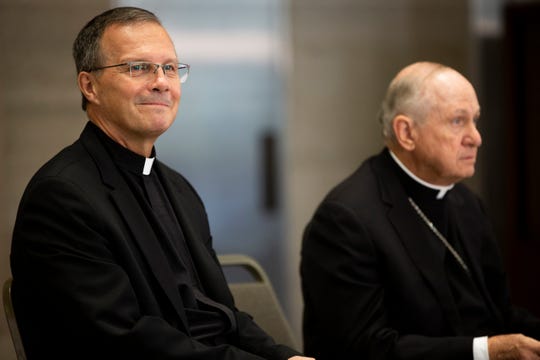
The priest whom Pope Francis selected to replace Des Moines Bishop Richard Pates is an Iowa State Cyclone, a philosophy professor and a self-described "Iowa guy."

The Rev. William Joensen will be the 10th bishop for the capital city diocese. The Iowa State University grad, who attended medical school before being called to the priesthood, addressed Catholics Thursday morning, shortly after the Vatican announced him as bishop-elect.

Later Thursday, Joensen celebrated Mass at a downtown service and ate a meal at a Catholic Charities homeless shelter — the same gesture Pates made when he was appointed to the role 11 years ago.

Joensen said he was initially shocked to get the phone call, less than two weeks ago, that he was being named the next bishop.
continue at Des Moines Register

Des Moines IA Diocese says it was scammed out of nearly $46,000

The Roman Catholic Diocese of Des Moines says it's been cyberscammed out of nearly $46,000.

The diocese says in a news release that a person or a group impersonating a diocese employee requested on Dec. 13 that the money be transferred. The diocese says it expects insurance will cover most of the loss.
continue at LSE Tribune

Des Moines IA Catholic Bishop Richard Pates announces retirement

Bishop Richard Pates, the leader of Catholic Diocese of Des Moines, is retiring and returning to the Archdiocese of St. Paul and Minneapolis, according to a column he wrote in The Catholic Mirror.

Pates turned 75 on Feb. 12, the age bishops must submit their resignation to the pope as part of Canon Law. In his column, Pates said he sent Pope Francis his resignation. He served as the ninth bishop of Des Moines.

"As I prepare to take leave, my heart is full of joy and gratitude," Pates wrote in the column. "The past 10 years in the Des Moines diocese have flown by."

Pates wrote that it takes four months or longer to find a new bishop.

He said he still plans to visit Des Moines.
Des Moines Register 


Iowa bishop says diocese stands ‘in solidarity’ with local police

In response to the fatal shootings Nov. 2 of two police officers, Bishop Richard Pates of Des Moines said the diocese stands in solidarity with members of the local police force.

The Catholic community “extends heartfelt prayer and sympathy to the families and friends of the two police officers who were killed in the line of duty,” the bishop said in a statement. Bishop Pates is a former auxiliary bishop of the Archdiocese of St. Paul and Minneapolis.

The two Des Moines-area police officers were shot shortly after 1 a.m. local time less than 2 miles apart in separate ambush-style attacks while they were in their patrol cars. Eight hours later, authorities apprehended a man suspected in the killings.

“This painful moment calls for a full investigation of the incidents, a response of justice and a continuing conversation of the entire community in seeking to resolve conflict in a peaceful manner,” said Bishop Pates, adding that one particular concern is that needs to be addressed is the “widespread proliferation of guns which makes such violence possible in the first place.”
continue at TCS 

Catholic Diocese of Sioux City, Iowa to close 41 parishes

The Catholic Diocese of Sioux City plans to begin consolidating 41 parishes during summer 2017.

The office unveiled a proposal Thursday that would reduce the number of the diocese’s parishes from 108 to 67, due to a shortage of priests and decreased Mass attendance.

In the last eight years, only 16 out the 108 parishes have grown, according to the Associated Press. Overall Mass attendance has dropped nearly 25 percent since 2008.  [these numbers are from the AP or from the diocese?]

Parishes being consolidated will become oratories, meaning there will be no weekly worship services. An oratory will still be able to host a variety of social functions, such as prayer services, funerals and weddings. None of the buildings will close [yet] but oratories will be maintained by the parish receiving the worshippers of consolidated parishes.

Bishop Richard Pates of the Des Moines Diocese said the city and surrounding neighborhoods are not facing similar problems. In fact, he said, the Des Moines Catholic population has seen roughly 10 percent growth over the last few years.
continue at Des Moines Register

Iowa Catholic Worker House hosts "priestess" for "Mass," diocese reprimands

A Des Moines Catholic group has been told it can no longer host Mass after allowing a woman to perform sacramental services in December.

Bishop Richard Pates of the Diocese of Des Moines ordered the Catholic Worker House to cease holding services in a letter dated May 5. An article explaining the ruling appeared in the August issue of "The Catholic Mirror," the diocese's monthly newspaper.

"This matter has been reviewed by the Presbyteral Council of the Diocese of Des Moines," the letter reads. "Members expressed great offense at this action of a rite that is so precious to them and others."

The council of priests voted unanimously to strip the Des Moines Catholic Worker House of its authority to hold Mass "for the time.”
continue at Des Moines Register

The article's author seems to either not understand the details of this story or to simply be advocating for her own personal opinion.

HT FrER

Iowa priest's role in telemed abortion ban challenged

Planned Parenthood of the Heartland contends that a prominent Catholic priest played an “outsized role” in the state medical board’s decision to ban use of a tele­medicine system for providing abortion pills.

Planned Parenthood’s complaint is aimed at Msgr. Frank Bognanno, who has been a member of the Iowa Board of Medicine since 2012. Bognanno, who has been an outspoken abortion opponent, took part in an 8-2 board vote last August to bar doctors from using Planned Parenthood’s video-conferencing system to dispense abortion pills to women in outlying clinics.

The medical board’s ruling is on hold while Planned Parenthood pursues a lawsuit in Polk County District Court. Planned Parenthood recently filed hundreds of pages of supporting documents in court. The information includes the allegation about Bognanno’s role.

Planned Parenthood said that a few weeks before last year’s board vote, Bognanno sent other board members dozens of pages of materials collected by anti-abortion groups.
continue at Des Moines Register

A well written article.

Some background:
Kilimanjaro-climbing Iowa priest nominated to medical board

Climb every mountain: a priest’s journey up Kilimanjaro

Several Iowa Catholic institutions named in a new CCHD investigative report

In one of its 2011 newsletters, CCHD proudly describes the work of grantee AMOS, an acronym for A Mid-Iowa Organizing Strategy. AMOS is a local affiliate of the Industrial Areas Foundation, an Alinskyian organizing network that rallies congregations and other institutions for political advocacy.

AMOS was given a CCHD grant to help it advocate for a mobile obstetric clinic. “The mobile clinic is the happy result of a five-year effort by AMOS’s 29 member organizations, including Catholic parishes in the Archdiocese of Dubuque and the Diocese of Des Moines.”[i]

AMOS was one of four organizations involved in creating the Ames clinic. ‘The clinic was created from a partnership of AMOS (A Mid-Iowa Organizing Strategy), MICA (Mid-Iowa Community Action), Broadlawn Hospital in Des Moines, and Des Moines University.”[ii] It’s insightful to look at these other partners.

MICA (Mid-Iowa Community Action) is one of a number of associated organizations were established in the 1960s as “delivery systems that maximize the federal, state and local resources in providing services to citizens.”[iii] That is, they connect poorer citizens into government-funded programs such as Head Start, Women, Infants, and Children (WIC), and others.[iv]

Among the key programs MICA uses is PROMISE JOBS, described as a “supportive, informational, and a true collaborative effort [that] gives each family an opportunity to access not only positive programs but an increased network of support.” [v] Available to all PROMISE JOBS participants – and therefore to all MICA clients - are “Family Planning Services – An option for everyone referred to PROMISE JOBS. Participants can find out how additional children can affect a family’s finances.”[vi]

Then, there’s Broadlawns Medical Center – a hospital – in Des Moines, another one of the partners that, along with the CCHD-funded AMOS, was responsible for establishing the Ames Mobile Clinic. Broadlawns’ Variety Club Women’s Health Center Family Planning Clinic provides a broad range of “specialized services and care for women” that include birth control counseling, emergency contraception, and something ominously called “pregnancy options,”[vii] a term used by Planned Parenthood to include abortion.
 continue at Spero News

Teacher at Iowa Catholic High School invites radically pro-abortion Obama to campaign

The first graf tells the story, almost:

President Barack Obama chose the backyard of a Catholic Des Moines family Sept. 29 to talk about issues ranging from the economy and taxes to education, poverty and health care.

That's a bit misleading. The "Catholic Des Moines family" OFFERED their backyard to B. Hussein Partial-Birth-Abortion Enabler, and he accepted their offer.

The family's head, by the way, teaches "social studies" at the Des Moines Catholic HS.
Dad29

Iowa Catholic Conference makes new voting flyer available

St Michael, Redemption Grotto, West Bend, Iowa

ASK THESE QUESTIONS OF CANDIDATES IN IOWA

An affirmative answer would be consistent with the positions of the Iowa Catholic Conference. Do you support:

• Protecting the dignity of human life from conception until natural death?
• Placing restrictions on abortion funding and mandates?
• Ensuring alternatives to abortion by funding organizations that assist women in crisis pregnancies?
• Requiring a 24-hour reflection period before an abortion?
• Restoring Iowa’s ban on all human cloning and prohibiting embryonic stem cell research?
• Maintaining Iowa’s status as a “no death penalty” state?
• Passing legislation that helps all immigrants provide for their families and become participating members of their communities?
• Enacting a fair and just tax system, a just living wage, and fair and reasonable labor practices by employers?
• Passing legislation to outlaw unfair lending practices?
• Establishing community-based corrections for prisoners who are not a threat to the community?
• Passing measures to preserve, protect and improve the quality of the air, water and land?
• Increasing tax credits to individual and corporate contributors to a “school tuition organization” for scholarships to low-income children so they may attend a nonpublic school?
• Increasing funding for textbooks, transportation and technology for children in public and nonpublic schools?
• Amending Iowa’s Constitution to recognize marriage only as a union of one man and one woman?
The way to do this is by convening a constitutional convention. Every 10 years, including this year, Iowa voters have the opportunity to call for a constitutional convention. A “yes” vote on this measure will allow Catholics and others to work for a marriage amendment to the Iowa Constitution. This amendment would affirm the traditional understanding that marriage is a union of one man and one woman.
Check out the full Faithful Citizenship Iowa

Why this sucks:
Why are we putting "unfair lending practices" on the same level as "protecting human life?"  This is yet another failure of the USCCB's Faithful Citizenship and does a DIS-service to the pro-life community by muddying the waters for pro-choice Catholic politicians to now hide behind the argument that they support some of the issues important to Catholics.  Issues of Life and Family are not negotiable with our politicians.  Until bishops make that clear, these lists(which ARE good) will be misused by our enemies as a Church endorsement for someone who supports " improve the quality of the air" but is still an unwavering abortion supporter.  I DO think it is a good list, but we have to take into account that American Liberalism is a religion unto itself.  They are only looking to conform their religion to fit into their political party's platform.  For bishops to be effective, they must have a list of non-negotiables.

Photo Tammy @ Flickr
Rekha Basu: Abortion book sale

Fifty years ago, some birth control advocates were puzzling over how to fill a $3,000 budget gap facing the Planned Parenthood Committee of Des Moines, which provided reproductive health care and education at low or no cost. United Way had refused before, according to Jim Vickery, a board member at the time. A bake sale wouldn't do it. The money from lunches that female volunteers cooked and sold didn't come close to meeting the need, at a time when Mother's Day Dinner at the Kirkwood could be had for $2.25. Nor had the attempted movie screenings born much fruit. They needed something big.

It was Maddie Glazer (later Levitt), the late philanthropist, who suggested selling used books.

It was a stroke of brilliance.  [Not to be confused with the stroke of death] The first Planned Parenthood Book Sale, held at the vacated site of the former Katz drug store at Seventh and Locust, brought in $2,650 over five days. Interest was so great, in fact, that by the second day, an appeal went out for more donations above the 10,000 books originally set out. Joan Mannheimer was the sale's first chairperson. "We knew nothing, practically," she said. "We worked long and hard. We were simply overwhelmed."  [LOL, do you think any of them were ever read?]

The beauty of the idea [ideas are beautiful but not babies] was that it benefited everyone: People had books they no longer had use or space for, which others could buy at a greatly reduced price. There were no labor costs since volunteers picked up and sorted the books and ran the sales at vacated storefronts: The drug store, the Salvation Army basement, a shoe and two furniture stores. Each of Planned Parenthood's approximately 24 board members was asked to come up with 300 books to sell, according to Vickery, a former insurance company president who joined the board that year. He quips that his late boss, Jim Green, brought him on because, "I think he thought after four children, my wife and I needed further education."  [With the dawn of the internet it is very hard to sell Planned Parenthood as just one charity amongst many.  Planned Parenthood is controversial, despite Rekha Basu damage control efforts.]

When the following year's sale opened, the Register reported, "Customers, some with a purposeful gleam in their eyes, others browsing at random, poured into the store at 809 Walnut seeking bargains in books."

Whatever that "purposeful gleam" referred to - Cheap books? Contraception? Sex?- the Planned Parenthood Book Sale, which opens next week for its 50th year, has been a bonanza. Now it's held twice, in fall and spring, at the 4-H building. Combined, the sales bring in nearly half a million dollars a year. Another mark of its success is that the Iowa Right to Life Committee has responded by holding its own book sale on the same dates.  [And Iowa Right to Life exists without taxpayer funding, correct?]

Many have looked forward to the annual rite of fall at the Iowa State fairgrounds' Agriculture building, where the sale was housed for 35 years. Row upon well-organized row of tables is loaded with books of every genre and author, and browsers move about with shopping carts and boxes. Each sale now boasts of some 300,000 items including books, CDs, DVDs and games. Each one has 300 to 400 volunteers, in addition to the 125 year-round ones.  [Some of which can only otherwise be found in adult book stores.]

What drives those people to devote such time and energy to the often mundane work of collecting, sorting, pricing and selling old books? To understand, go back to a time when women "had no choice, no birth control," in the words of Laurie Sloterdyke, Planned Parenthood's events manager. Many of those women are still around, she says, "and they are very passionate about it."  [Oh yes that's right, it was women's fertility that caused them to be unable to vote, right?  Progesterone Pill Births Woman's Suffrage!]

In 1961, the birth control pill had just arrived on the market creating, according to Barbara Madden-Bittle, a former clinic staffer, board president and book sale chair, "a whole revolution for women." A nurse, she used to go door to door in low-income neighborhoods, educating women about birth control and inviting them into the clinic for exams. Some had multiple children and couldn't afford to feed more. For some, another pregnancy carried health risks.  [I wonder if they told women about the health risks of contraception?  I guess not.]

While some women went on the pill without telling their husbands, some husbands were thrilled because they could now have sex without worrying about a pregnancy, says Madden-Bittle. But it wasn't just about sex, she says. It opened up new choices for what women could do with their lives. [LOL!  What romance!]

Well before that, when the precursor to Planned Parenthood was founded as the Iowa Maternal Health League in 1934, women began coming to the clinic for other forms of birth control in the face of federal laws against dispensing it. Previously they had resorted to homemade devices to limit their family sizes. Mannheimer's late mother-in-law, Erma Mannheimer, was one of the four founders of the Des Moines clinic. "Erma told me that in the beginning, she used a sponge soaked in a spermicide with a string attached," said Mannheimer. Early on, her mother-in-law and the other three founders used to joke that if they were sent to jail, at least there'd be enough for a bridge game.  [Planned Parenthood, a long history of ethical legal practice.]

Planned Parenthood founder Margaret Sanger, who had opened the country's first birth control clinic in New York in 1916, regularly got arrested for publishing and distributing pregnancy-prevention information before a federal court ruling in 1936 eased the restrictions.  [Maybe because she wanted to wipe out all African Americans?]

The Iowa Maternal Health League founders were women of means who had personal physicians, but wanted to make services available to low-income women, according to a 1937 Register story. When clinic clients were offered birth control for the first time, some confused it with abortions. And when examined, some clients were found to be pregnant or in need of surgery without knowing it. The story said the pregnant ones were sent home to have their babies.  [Oh how times have changed.]

The 782 women who came through the clinic in its first two years had between them 479 abortions before coming. "I think that record speaks for itself of the desperation of women who are not able to know an efficient and harmless method for controlling the size of their families," Myrtle Eldred, a co-chairperson was quoted as saying. 

Hearing this history makes one realize how much about the ability to control our fertility we take for granted today - and what a subversive and courageous act it once was to help other women control theirs.  [Wouldn't it be interesting if abortion fans worked with their fertility instead of working against it?]

But it's a right that continues to need defending. Not only have some drugstores and pharmacists launched moves to deny contraception to customers, but Madden-Bittle, who worked for 22 years as a school nurse in Des Moines, has seen the rate of sexually transmitted diseases, and resulting infertility, steadily increase. She blames eight years of the Bush administration's abstinence-only requirement in schools for young people lacking accurate information and engaging in high risk, unprotected sex.  [LULZ!!! Did you know that Bush also single-handedly caused Hurricane Katrina to help out his Big Oil Buddies and brought in help from aliens at area-51 to poison corn crops?  Look at the numbers Ms. Basu, they don't lie.]

Madden-Bittle says the intense polarization that exists today around pregnancy prevention didn't exist back then - even after Roe v. Wade legalized abortion in 1973. Though the Catholic Church was strong, opponents weren't as well organized, she says. "Nobody dreamed it was going to get so toxic."  [I guess science is "toxic" when it doesn't agree with your world view]

In fact, in 1962, Monsignor J.D. Conway of Davenport said he opposed legislative prohibition on contraceptive prescriptions, noting, "You cannot legislate a moral thing."  [a moral thing like child porn??] And in the early '60s, 108 Iowa pastors joined with thousands around the country in supporting spacing children through planned parenthood to "improve the mental and physical health and economic status of the American family."  [And as the '60s crowd now crash and burn, it turns out the next generation chooses life.]

Today, in the face of growing backlash against doctors who do abortions, it's hard to find one outside of Planned Parenthood or the Emma Goldman Clinic in Iowa City who still does, Madden-Bittle said. And she said Planned Parenthood had to buy a bullet proof vest for its doctor: "You don't know her name. You won't ever see her. She is not public."  [It's those damn kids praying and handing out fliers for sure!]

What is striking is how cyclical these issues are. Though each generation thinks it is uniquely modern and liberated, some of the same battles have been repeating themselves for 100 years. That's because, as other social movements come and go, the struggle by women to control their fertility - and thus, their lives - is a timeless one. And that has driven many generations to activism. For the Planned Parenthood book sale volunteers, sorting and selling books is just a non-subversive form of it.  [It is true, abortion and contraception have been around since before the time of Christ.  That is why the Catholic Church has always condemned them for 2000 years and counting, because they rob women of their true identity and destroy their bodies through the lie of consequence free sexuality.]

But will the effort continue to generate the same passion when the generation that witnessed its beginnings is gone? And what happens if technologies like Kindle and iPad someday make paper books obsolete? 

The history suggests that as long as women seek reproductive choice, people will find unique, creative and passionate ways to support it.  [Like stabbings a man with scissors or grabbing his crotch]
DesMoinesRegister via Is Anybody There