Showing posts with label Music. Show all posts
Showing posts with label Music. Show all posts

St Louis Catholic: "Did They Speak Out Against Him, Did They Dare?"

The quote in the post title above comes from Dylan's "In the Garden", from his vastly underappreciated 1980 album Saved. It refers, of course, to Our Lord, and asks in wonder whether after all He had done and said, that the chief priests had the audacity to speak against Him.continue at Saint Louis Catholic
Well, Bob is not Our Lord, but he has been singularly blessed by Him with the gift of poetry in the service of beauty and truth. Still, many speak out against him, how they dare I don't know.
Today it was announced that Bob Dylan is the winner of the 2016 Nobel Prize for Literature. 'Bout time.
Also check out the backhanded compliment by the Vatican press office: Catholic Dylan Doubters: I've Got You Now
B.B. King R.I.P.
B.B. King gave his guitar "Lucille" to Pope John Paul II in connection with performing at the 1997 Vatican Christmas Concert,
MTV then reported.
(A photo of Mr. King and the Pope accompanies
this article.)
A brief clip from King's performance is included in
this complilation at YouTube.

Daniel Silliman recounts 'How the church gave B.B. King the blues' at The Washington Post.
"'There’s a blues for anything that bothers you,' he said. 'I listen to gospel music and, believe it or not, I hear the same thing.'...On that almost religious note, here was the marquee in Manhattan last December.
"Despite that recognition, King didn’t find his way back to church in his later years. He remembered the Church of God in Christ fondly, and said in interviews that 'the sanctified people are the singingest people.' He also remembered the Rev. Archie Fair [who first taught him guitar chords] fondly, and when he performed for Pope John Paul II in 1997, King said the pope reminded him of the Mississippi pentecostal preacher of his youth. Both men, he said, made you feel like they could get a message to God on your behalf."

FirstThings: Bob Dylan must get stoned

Journalists have always been puzzled by Bob Dylan, but the confusion is of their own making. The pattern of treating him as a trickster whose words cannot be taken at face value was established in the sixties, when the rock intelligentsia wanted Dylan to be a political as well as musical revolutionary. He was neither, of course. His radicalness came from a deeply conservative understanding of musical history: He was reading Civil War era newspapers while everyone else was reading Norman O. Brown and listening to Gospel and Blues when music was becoming “pop” in the fifties. But the story of the sixties wasn’t complete without Dylan as its hero. His so-called followers couldn’t take no as an answer: His denials became obfuscations.continue at First Things
Of course, Dylan can be verbally perverse in interviews, but who can blame him when those who should know better seem clueless to what he is saying? Occasionally in these charades of misunderstanding, Dylan gets so frustrated that he spells everything out, revealing probably more than he intended. Such was the case in a Rolling Stone 2012 interview with Mikal Gilmore.
The interview begins to go wrong for Gilmore (and right for the rest of us) when he asks about “Rainy Day Women.” Dylan says that those who view it as a drug song “aren’t familiar with the Book of Acts.” This comment goes so far over Gilmore’s head that he can’t even respond to it.
Which shows he has no business interviewing Dylan, who has always been immersed in the Bible, its language and its theology. “Rainy Day Women” is more about persecution than intoxication. It sounds like a Salvation Army band playing a funeral march, but its words are deadly serious. When Dylan says that “they’ll stone ya when you’re trying to be so good” and that “they’ll stone ya when you’re tryin’ to go home,” he is speaking straight from the Bible. His comment about the Book of Acts makes the reference more explicit: it’s not just any good man being stoned, but Stephen.
I should have listened to timman.
Photo
Blues Benefit Party to support Our Lady of Hope Clinic on Monday, July 8

Our Lady of Hope Clinic is a 100 percent pro-life family practice clinic located in Madison, WI that also provides a ton of free health care to patients with no health insurance. Matt has written on it before, and at some point I really ought to do a longer-form piece detailing the clinic's model and mission because they're doing fantastic work.
I'm partial to Our Lady of Hope Clinic for many reasons--perhaps the most important one being that without it, I probably wouldn't have my son.
Because the clinic is a relatively new apostolate (it opened in 2009) and has a unique model, fundraising can be difficult. That's why it's super exciting that a Madison-area supporter is throwing a benefit concert on Monday night to help fund it.
W.C. Clark and his Midwest Blues Review will be doing a benefit for "Our Lady of Hope" free clinic on Odana Road, Monday July 8 at Club Tavern (1915 Branch Street, Middleton, Wisconsin 53562). All donations go to the clinic that helps folks in need without insurance. Thi sis the only Madison date this summer and the last date for the band before W.C. heads to Canada. Joining WC Clark will be Ken Saydak (keyboard), Bill Roberts and Jim Ohlschmidt (guitar), Chris Sandoval (drums), Tony Menzer (bass), and Tom Sobel (saxophone). There will be no cover charge at the door; however a free-will donation will be greatly appreciated.
Now, I'm a HUGE fan of blues music, so I'd want to go anyway. But to get to listen to a hot blues band AND support OLHC, well, it just doesn't get any better than that.
I'll be there, and I'd love to see you there too!
Singing Scripture throughout Mass: Why We Must and How We Might
(Reposted from Corpus Christi Watershed)
For a long while I've been ruminating on the nature of the Liturgy, Scripture as found in the Mass Propers, the Golden Calf narrative (thanks to Ratzinger's Spirit of the Liturgy), Good Friday tradition, and episcopal authority. Here are some semi-organized thoughts on the matter.
Nature of the Sacred Liturgy:
The Sacred Liturgy is Christ's eternal offering to the Father, in which we participate "through him, with him, and in him in the unity of the Holy Spirit": Christ makes the perfect sacrifice, and we configure ourselves to it through submission to his liturgical action as laid down by the Church—"without me you can do nothing" (John 15:5).
The Latin Rite, Scripture and its Nature, and the Mass Propers:
On paper, the Latin Rite Mass may well be the most explicitly Scriptural rite in all of Christendom. Scripture is not limited to the readings and psalms of the Liturgy of the Word. The Order of Mass itself is awash in Scripture. Moreover, the proper texts of the Mass—most neglected during the Processions of the Mass—come from the psalms, Old and New Testament canticles, and Gospel/Epistle passages. (Non-Scriptural proper texts are insignificant in number compared to the vast array of Scripture intended to be sung—and even these non-Scriptural texts are in most cases to be paired with verses from Scripture when possible.)
What does Jesus sing? Psalms were sung perfectly by Christ to the Heavenly Father during his earthly life as the perfect Jew, making the perfect sacrifice to the Father by following the Law perfectly in every way (Matthew 5:17). As Christ is the Eternal Word (John 1:1), the words he utters are a touchstone to eternity; they echo forever. Therefore, when the Propers are sung, Christ sings—I tell my choirs that singing Scripture allows for a "communion" of sorts even before they receive his Body, Blood, Soul and Divinity; "they do not sing, but Christ sings through them" (cf. Galatians 2:20).
Liturgical Norms: GIRM (I use the US edition since this is where I live), via the examples given in the ritual books cited, calls for Scripture to be sung at the three processions of the Mass (GIRM 48, 74, 87):
Golden Calf, Good Friday, and neglect/abuse of episcopal authority in the liturgy:
The Golden Calf and GIRM Option 4: Aaron the high priest fashioned the calf from the contributions of the people, at the behest of the people (Exodus 32:1–6). God did not approve this; in fact he hated it to the point of eradicating his chosen people (Exodus 32:7–10); but the people may well have led themselves to believe that Aaron's command was divine (neglect of priestly authority, i.e., "Aaron allowed us to do it, so it must be right"). Ratzinger observes that the people may have believed they were truly worshiping God, though of course they were not (Spirit of the Liturgy 22–23). When Moses confronts Aaron about the abuse he committed, Aaron heaps more sin upon his misdeed by being disingenous ("I cast it into the fire, and this calf came out", cf. Exodus 32:24). The rest of Exodus 32 outlines the grave consequences of this error.
In the United States, Option 4 allows "another suitable liturgical song" approved by the bishops. Despite many suitable liturgical songs from the treasury of the Church's liturgy (hymns of the Liturgy of the Hours, Sequences, Litanies, Responsories, etc.), many songbooks intended for use in the liturgy and "printed with ecclesiastical approval" include texts of questionable merit. The people in this instance believe they are worshipping God in spirit and truth, but is that the case? People are developing an attachment to these words, but are the words of Christ?
Good Friday and Option 4: Barabbas means "Son of the father"; tradition tells us that his first name also was Jesus (i.e., "God saves"). The mob, incited by the high priests and scribes, chose Barabbas—a savior of their own imagining—to be released instead of the true Savior, the Son of the Eternal Father. With the new Mass, Option 4 allows the Word of God (Options 1–3) to be cast aside for words of people's own choosing. In doing so, do we not unwittingly repeat Good Friday, in that we choose the words of man over the Word of God living and effective (Hebrews 4:12)?
At least with the Responsorial Psalm there is clearly delineated demand for Scripture: "Nor is it lawful to replace the readings and Responsorial Psalm, which contain the Word of God, with other, non-biblical texts" (GIRM 57). But the Church also demands Scripture be retained for the processional chants of the Mass (Sacrosanctum Concilium 116).
Episcopal Authority: Until the bishops speak and act in one voice on the matter, calling for the restoration of the Word of God to God's own liturgy, individual bishops, priests, and laity sympathetic to the sung Mass, propers in their Gregorian/polyphonic genres, etc., are stuck with "more Catholic than the Pope" accusations, etc. The biological solution works on everyone, and for those unsympathetic to these genres, they too can play a "waiting game". How many people consider Benedict XVI's pontificate a blip on the radar?
GIRM Option 3, a "third way" back to Scriptural liturgy regardless of musical style
Sidestepping the style wars: Dr. Mahrt and others have made very persuasive arguments for music stylistically proper to liturgy. Despite the many advances that have been made in certain parishes, other parishes seem to be stuck in the style wars, with no end in sight. Still other parishes retain music repertoires that are heavily or exclusively influenced by popular secular styles. In many of these cases more headway might be made when energy is focused on the textual justification for propers/singing of Psalms at the processions. Msgr. Wadsworth of ICEL has proposed the unity of the Roman liturgy is in its texts (cf. 2010 CMAA Colloquium keynote).
Option 3 as a textual upgrade from Option 4 as popularly applied: An Option 3 solution—"a chant from another collection of Psalms and antiphons, approved by the Conference of Bishops or the Diocesan Bishop, including Psalms arranged in responsorial or metrical forms"—regardless of the musical style, would constitute a vast improvement over the Option 4 fare that passes for worship. Since selections from Option 3 have a greater guarantee of being Scriptural, they are more likely to allow access to singing with Christ to the Father rather than singing amongst ourselves.
Many Option 3 selections are well-known in some way: Many settings of Responsorial Psalms and their paraphrases are well-established staples of existing ensembles' and congregations' repertoires; therefore, using these at the Entrance, Offertory, and Communion would not constitute a wholesale discarding of repertoire, which in some cases has taken much effort to master. Other selections that can fall under Option 3, e.g., Hymn Tune Introits, are easily adapted to hymn tunes that exist in parish repertoire.
Textual upgrade, not stylistic downgrade: Since Gregorian chant is the sung prayer proper to the Roman Rite, Masses that incorporate the propers in this idiom should not be eliminated, nor should efforts to learn this repertoire be abandoned. However, in those environments where this is not feasible in any way, moving from Option 4 to Option 3 would foster throughout the Mystical Body of Christ a greater unity with him who makes his eternal song to the Father.
May be the only way forward in many places: Singing Scripture that is clearly identifiable as such would go a long way towards fostering true unity in the Church's liturgy—a unity centered on and in Jesus Christ, who alone makes the true sacrifice to our heavenly Father. In places that frown upon the Church's traditional ritual music, moving from non-Scriptural lyrics to Scriptural lyrics may be the only feasible transition at this time.
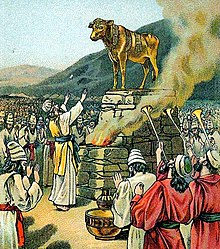 |
| Worshiping God: you're doing it wrong |
Nature of the Sacred Liturgy:
The Sacred Liturgy is Christ's eternal offering to the Father, in which we participate "through him, with him, and in him in the unity of the Holy Spirit": Christ makes the perfect sacrifice, and we configure ourselves to it through submission to his liturgical action as laid down by the Church—"without me you can do nothing" (John 15:5).
The Latin Rite, Scripture and its Nature, and the Mass Propers:
On paper, the Latin Rite Mass may well be the most explicitly Scriptural rite in all of Christendom. Scripture is not limited to the readings and psalms of the Liturgy of the Word. The Order of Mass itself is awash in Scripture. Moreover, the proper texts of the Mass—most neglected during the Processions of the Mass—come from the psalms, Old and New Testament canticles, and Gospel/Epistle passages. (Non-Scriptural proper texts are insignificant in number compared to the vast array of Scripture intended to be sung—and even these non-Scriptural texts are in most cases to be paired with verses from Scripture when possible.)
What does Jesus sing? Psalms were sung perfectly by Christ to the Heavenly Father during his earthly life as the perfect Jew, making the perfect sacrifice to the Father by following the Law perfectly in every way (Matthew 5:17). As Christ is the Eternal Word (John 1:1), the words he utters are a touchstone to eternity; they echo forever. Therefore, when the Propers are sung, Christ sings—I tell my choirs that singing Scripture allows for a "communion" of sorts even before they receive his Body, Blood, Soul and Divinity; "they do not sing, but Christ sings through them" (cf. Galatians 2:20).
Liturgical Norms: GIRM (I use the US edition since this is where I live), via the examples given in the ritual books cited, calls for Scripture to be sung at the three processions of the Mass (GIRM 48, 74, 87):
- Option 1 prescribes the Proper (Missal or Roman Gradual) — scriptural
- Option 2 prescribes the Proper (Simple Gradual) — scriptural
- Option 3 prescribes selections from other collections of Psalms and antiphons, provided they are approved by the bishops — scriptural
Golden Calf, Good Friday, and neglect/abuse of episcopal authority in the liturgy:
The Golden Calf and GIRM Option 4: Aaron the high priest fashioned the calf from the contributions of the people, at the behest of the people (Exodus 32:1–6). God did not approve this; in fact he hated it to the point of eradicating his chosen people (Exodus 32:7–10); but the people may well have led themselves to believe that Aaron's command was divine (neglect of priestly authority, i.e., "Aaron allowed us to do it, so it must be right"). Ratzinger observes that the people may have believed they were truly worshiping God, though of course they were not (Spirit of the Liturgy 22–23). When Moses confronts Aaron about the abuse he committed, Aaron heaps more sin upon his misdeed by being disingenous ("I cast it into the fire, and this calf came out", cf. Exodus 32:24). The rest of Exodus 32 outlines the grave consequences of this error.
In the United States, Option 4 allows "another suitable liturgical song" approved by the bishops. Despite many suitable liturgical songs from the treasury of the Church's liturgy (hymns of the Liturgy of the Hours, Sequences, Litanies, Responsories, etc.), many songbooks intended for use in the liturgy and "printed with ecclesiastical approval" include texts of questionable merit. The people in this instance believe they are worshipping God in spirit and truth, but is that the case? People are developing an attachment to these words, but are the words of Christ?
Good Friday and Option 4: Barabbas means "Son of the father"; tradition tells us that his first name also was Jesus (i.e., "God saves"). The mob, incited by the high priests and scribes, chose Barabbas—a savior of their own imagining—to be released instead of the true Savior, the Son of the Eternal Father. With the new Mass, Option 4 allows the Word of God (Options 1–3) to be cast aside for words of people's own choosing. In doing so, do we not unwittingly repeat Good Friday, in that we choose the words of man over the Word of God living and effective (Hebrews 4:12)?
At least with the Responsorial Psalm there is clearly delineated demand for Scripture: "Nor is it lawful to replace the readings and Responsorial Psalm, which contain the Word of God, with other, non-biblical texts" (GIRM 57). But the Church also demands Scripture be retained for the processional chants of the Mass (Sacrosanctum Concilium 116).
Episcopal Authority: Until the bishops speak and act in one voice on the matter, calling for the restoration of the Word of God to God's own liturgy, individual bishops, priests, and laity sympathetic to the sung Mass, propers in their Gregorian/polyphonic genres, etc., are stuck with "more Catholic than the Pope" accusations, etc. The biological solution works on everyone, and for those unsympathetic to these genres, they too can play a "waiting game". How many people consider Benedict XVI's pontificate a blip on the radar?
GIRM Option 3, a "third way" back to Scriptural liturgy regardless of musical style
Sidestepping the style wars: Dr. Mahrt and others have made very persuasive arguments for music stylistically proper to liturgy. Despite the many advances that have been made in certain parishes, other parishes seem to be stuck in the style wars, with no end in sight. Still other parishes retain music repertoires that are heavily or exclusively influenced by popular secular styles. In many of these cases more headway might be made when energy is focused on the textual justification for propers/singing of Psalms at the processions. Msgr. Wadsworth of ICEL has proposed the unity of the Roman liturgy is in its texts (cf. 2010 CMAA Colloquium keynote).
Option 3 as a textual upgrade from Option 4 as popularly applied: An Option 3 solution—"a chant from another collection of Psalms and antiphons, approved by the Conference of Bishops or the Diocesan Bishop, including Psalms arranged in responsorial or metrical forms"—regardless of the musical style, would constitute a vast improvement over the Option 4 fare that passes for worship. Since selections from Option 3 have a greater guarantee of being Scriptural, they are more likely to allow access to singing with Christ to the Father rather than singing amongst ourselves.
Many Option 3 selections are well-known in some way: Many settings of Responsorial Psalms and their paraphrases are well-established staples of existing ensembles' and congregations' repertoires; therefore, using these at the Entrance, Offertory, and Communion would not constitute a wholesale discarding of repertoire, which in some cases has taken much effort to master. Other selections that can fall under Option 3, e.g., Hymn Tune Introits, are easily adapted to hymn tunes that exist in parish repertoire.
Textual upgrade, not stylistic downgrade: Since Gregorian chant is the sung prayer proper to the Roman Rite, Masses that incorporate the propers in this idiom should not be eliminated, nor should efforts to learn this repertoire be abandoned. However, in those environments where this is not feasible in any way, moving from Option 4 to Option 3 would foster throughout the Mystical Body of Christ a greater unity with him who makes his eternal song to the Father.
May be the only way forward in many places: Singing Scripture that is clearly identifiable as such would go a long way towards fostering true unity in the Church's liturgy—a unity centered on and in Jesus Christ, who alone makes the true sacrifice to our heavenly Father. In places that frown upon the Church's traditional ritual music, moving from non-Scriptural lyrics to Scriptural lyrics may be the only feasible transition at this time.
Want to hear great church music? Head to the train station.
As a transplant from New York City who spent lots of time in the public transportation system (I commuted to high school from the suburbs for four years), I was astounded to discover this NYTimes story.
Here's the Wisconsin connection:
(HT Dcn. Kandra)
On a recent Sunday afternoon, 17 people with sheet music gathered in a semicircle in the Graybar Passage at Grand Central Terminal. People streamed by. After a brief warm-up, the group’s conductor, John Hetland, dressed in dark jeans and a green plaid shirt, lifted his hands and the chorus began its a cappella rendition of a polyphonic hymn, “Kyrie,” by the 15th-century German composer Heinrich Finck.I had never heard of this group until today; commuting to and from Long Island probably contributed to that. (Grand Central Terminal serves the suburbs north of Manhattan; and compared to GCT, NY Penn Station is positively ugly, both visually and acoustically.)
The hallway filled with sound, the baritones roiling like cumulonimbus clouds, the altos and sopranos shooting through like light, the melodies intertwining. The voices carried down the hall and were faintly audible in the Main Concourse. A crowd gathered to listen, but no one gave money, because there was nowhere to put it. When the song was over, Mr. Hetland turned around to face the small audience.
“We’re the Renaissance Street Singers,” he said, “singing the music that we love to sing and to share.”
Here's the Wisconsin connection:
Mr. Hetland, 71, has been singing choral music nearly all his life. His father, Henry Hetland, was a Lutheran campus minister at the University of Wisconsin-Madison (where students called him “Pastor Hank”) and, later, the executive secretary of the National Lutheran Campus Ministry in Oakland, Calif. In Wisconsin, he had directed a 50-voice choir, and he taught his four children to sing multipart hymns and folk songs to pass the time on long car rides. Soon, Mr. Hetland, his older sisters, Pauline and Maren, and his younger brother, Jim, were singing complex music as a treble quartet.Read more here.
(HT Dcn. Kandra)
Free Polyphony in Pine Bluff: Holy Thursday
Other kinds of sacred music, especially polyphony, are by no means excluded from liturgical celebrations, so long as they accord with the spirit of the liturgical action. — Vatican II Constitution on the Sacred Liturgy Sacrosanctum Concilium ¶116
The all-volunteer choir at St. Mary of Pine Bluff is not numerous at the moment: at full strength we number about a dozen. Moreover, as many of the members are called in any number of directions as befitting their primary vocation to be in the world, rehearsals aren't always fully attended. (I'll probably have a blog post on handling such matters in the future.) However, the choir has been blessed with pretty good ears, at least one sight-reader on every part, and most importantly a recognition that it is the Lord we serve at the Sacred Liturgy and not ourselves.
Here are a couple of choral pieces we hope to debut on Holy Thursday. Below is a fresh setting of the first verse of the hymn Ubi caritas, which the Ordinary Form of the Roman Rite assigns to the Offertory.[1]
R/. Where true charity is dwelling, God is present there.
V/. By the love of Christ we have been brought together:
V/. let us find in him our gladness and our pleasure;
V/. may we love him and revere him, God the living,
V/. and in love respect each other with sincere hearts.
R/. Where true charity is dwelling, God is present there. Amen, amen.
The second piece is a Renaissance-era setting of the text assigned for Communion.[2]
This is the body that will be given up for you;
this is the chalice of the new covenant in my blood, says the Lord;
do this, whenever you receive it, in memory of me. — 1 Cor 11:24–25
The first composition mentioned in this post was created in 2012; the second in the mid–16th century. Yet they can and will successfully stand side-by-side not also with each other but also with liturgical plainsong compositions from 2010 and the earliest eras of the Church's history. And both of these compositions are freely available on the Internet in PDF form (thus the "free" in the title of this post):
Footnotes:
[1] The Extraordinary Form of the Roman Rite assigns this hymn to the Washing of Feet.
[2] The Extraordinary Form of the Roman Rite assigns this text to Passion Sunday/Fifth Sunday of Lent.
Benedict XVI and an Incarnational Theology of Liturgical Music
Carolyn Pirtle, Assistant Director of the Notre Dame Center for Liturgy, offers a useful encapsulation of Benedict XVI's approach to the issue of liturgical music. An extended excerpt is below, with my emphases in boldface. Here is the full article.
For the psalmist, offering sung praise to God implied singing with an understanding that surpasses mere rationality and transcends into the realm of sapientia, or wisdom, which “denotes an integration of the entire person who not only understands and is understandable from the perspective of pure thought, but with all the dimensions of his or her existence” (98). Ratzinger goes on to say that “there is an affinity between wisdom and music, since in it such an integration of humanness occurs and the entire person becomes a being in accordance with logos [with ‘reason’]” (98). It is in singing that the senses and the spirit are integrated into one being, and in singing to God that the being is incorporated into logos.
Christianity takes this understanding one step farther by understanding the Psalms not merely as hymns written by King David, but as hymns that “had risen from the heart of the real David, Christ” (97). Thus, singing “hymns of praise” not only harmonizes the senses with the spirit, but when Christians understand those hymns as having their source in Christ, they are also drawn out of themselves into harmony with the Logos, the Word-made-flesh, as they offer sung praise in and through Christ Himself. With this mindset, “Christ Himself becomes the choir director who teaches us the new song and gives the Church the tone and way in which she can praise God appropriately and blend into the heavenly liturgy” (97). In order to offer fitting praise, one must conform one’s song to that of Christ, “who did not regard equality with God as something to be grasped; rather, he emptied himself, taking the form of a slave” (Phil 2:6-7). [Read full article]
(HT: Adam Bartlett/ChantCafe.com)
"When people rightly call for a new dialogue between Church and culture today, they must not forget in the process that this dialogue must necessarily be bilateral. It cannot consist in the Church finally subjecting herself to modern culture… Just as the Church must expose herself to the problems of our age in a radically new way, so too must culture be questioned anew about its groundlessness and its ground, and in the process be opened to a painful cure, that is, to a new reconciliation with religion since it can get its lifeblood only from there. For this reason church music is really a very vital piece of a comprehensive task for our age which requires more than mere dialogue; it requires a process of rediscovering ourselves." —Joseph Ratzinger, A New Song to the Lord (1995), 95–6For Ratzinger, this process of “rediscovering ourselves” necessitates a setting aside of the current debate surrounding liturgical music and the discussions it has generated (scholarly and otherwise). Doing so will facilitate a return to “the original source” in exploring connection between faith and music as well as the role of music in worship: the Bible. In turning to the Psalms in particular, Ratzinger establishes a theology of liturgical music in one verse: “Sing hymns of praise” (Ps 47:8, NRSV). True to his roots as a theologian who takes the biblical narrative seriously, Ratzinger engages this text in Hebrew, Greek, and Latin in order to arrive at a richer translation. Suffice it to say that singing hymns of praise well entails more than making pleasant-sounding music.
For the psalmist, offering sung praise to God implied singing with an understanding that surpasses mere rationality and transcends into the realm of sapientia, or wisdom, which “denotes an integration of the entire person who not only understands and is understandable from the perspective of pure thought, but with all the dimensions of his or her existence” (98). Ratzinger goes on to say that “there is an affinity between wisdom and music, since in it such an integration of humanness occurs and the entire person becomes a being in accordance with logos [with ‘reason’]” (98). It is in singing that the senses and the spirit are integrated into one being, and in singing to God that the being is incorporated into logos.
Christianity takes this understanding one step farther by understanding the Psalms not merely as hymns written by King David, but as hymns that “had risen from the heart of the real David, Christ” (97). Thus, singing “hymns of praise” not only harmonizes the senses with the spirit, but when Christians understand those hymns as having their source in Christ, they are also drawn out of themselves into harmony with the Logos, the Word-made-flesh, as they offer sung praise in and through Christ Himself. With this mindset, “Christ Himself becomes the choir director who teaches us the new song and gives the Church the tone and way in which she can praise God appropriately and blend into the heavenly liturgy” (97). In order to offer fitting praise, one must conform one’s song to that of Christ, “who did not regard equality with God as something to be grasped; rather, he emptied himself, taking the form of a slave” (Phil 2:6-7). [Read full article]
(HT: Adam Bartlett/ChantCafe.com)
A deacon on devotional and liturgical music
From a deacon at the Cathedral of the Madeleine in Salt Lake City:
My wife also enjoys listening to the local contemporary Christian radio station, and I appreciate the role that this music has played in her life of faith. But she has made no overtures to me about playing any of this repertoire in church, at Mass or otherwise. (Not that I have the final say in matters liturgical, anyway—that's the pastor's cross, ultimately.) Moreover, while we're listening in the car, she will point out theological errors in the lyrics whenever they occur.
Unlike many of my Catholic friends, I enjoy a fair amount of contemporary Christian music. My enjoyment of such music, by no means all of it, as much of is lamentably bad, has no liturgical implications, which means I have no desire for it to comprise any part of the Sacred Liturgy. But for devotional purposes, I find some of it wonderfully suitable in that way only music can be. (more)The Cathedral of the Madeleine happens to be the home of one of two Catholic elementary choir schools in the United States (here's the other), so it's safe to say that he has a fuller understanding of what constitutes liturgical music via lived experience.
My wife also enjoys listening to the local contemporary Christian radio station, and I appreciate the role that this music has played in her life of faith. But she has made no overtures to me about playing any of this repertoire in church, at Mass or otherwise. (Not that I have the final say in matters liturgical, anyway—that's the pastor's cross, ultimately.) Moreover, while we're listening in the car, she will point out theological errors in the lyrics whenever they occur.
Archbishop-designate Sample's Pastoral Letter on Sacred Music
On January 21 of this year Bishop Alexander Sample of Marquette issued "Rejoice in the Lord Always," a pastoral letter on Sacred Music in Divine Worship, but the PDF of it was uploaded only this morning. (H/T to Adam Bartlett of the Chant Café.) You may download it directly from the Diocese of Marquette's website here.
What struck me the most about this letter is that it calls for the following:
In any case, it's extremely refreshing to see the chief liturgist of a diocese teach and issue directives about the sacred liturgy that are in continuity with Church teaching. May their number increase.
And readers aware of the Proper of the Mass know that the beginning of the Entrance Antiphon for the Third Sunday of Advent is used for the title of this pastoral letter.
More analysis available at WDTPRS.
What struck me the most about this letter is that it calls for the following:
- Pastors and musicians to possess knowledge of the musical directives as found in Church documents (listed in the appendix) and to base preparations for liturgies on them;
- An understanding that one prepares for the liturgy instead of plans it (subtle but important distinction);
- At least one Sunday Mass per parish be a Sung Mass (missa cantata) according to the capabilities of the priest and faithful;
- An awareness of the nonliturgical nature of the "Recessional Hymn", calling for an instrumental piece or silence (in Lent);
- Moving toward the singing of the Proper of the Mass (Entrance/Offertory/Communion chants), while laying down tighter guidelines for hymn substitution of these Propers (which takes place on a widespread basis);
- Weekday Masses to incorporate some liturgical singing;
- All capable priests of the diocese to learn to pray the Roman Canon in chant according to the tones in the Missal;
- All parishes to learn two chant Mass settings (VIII and XVIII);
- All parishes to conduct Triduum liturgies a cappella from the Gloria of Holy Thursday until the Gloria of the Easter Vigil.
In any case, it's extremely refreshing to see the chief liturgist of a diocese teach and issue directives about the sacred liturgy that are in continuity with Church teaching. May their number increase.
And readers aware of the Proper of the Mass know that the beginning of the Entrance Antiphon for the Third Sunday of Advent is used for the title of this pastoral letter.
More analysis available at WDTPRS.
Fassino: Why I hate bad church music
 |
| Nico Fassino |
Recently, the Catholic Herald published two excellent articles by the incredibly well-educated and well-formed Sr. Joan L. Roccasalvo, entitled “Rebuilding Catholic Culture.”continue at MadCatHerald
In these essays, Sister Roccasalvo vigorously defends the teachings of the popes and the Second Vatican Council concerning what music is proper for use during the sacred liturgies of the Church, while simultaneously arguing against the use of modern folk-style music commonly found in many parishes.
Response to letter writers
I decided to write this piece after reading several letters-to-the-editor written by people who were very unhappy with her columns.
I actually wanted to title this column “In Defense of Sacred Music: Why the Celebration of Christ’s Death and Resurrection at the All-Holy Mass Deserves Something Better Than Low-Brow Tripe,” but that was obviously too long and I figured that “Why I hate bad Church music” would still draw the eyes of those I wanted to reach.
Some people are upset that Sister Roccasalvo condemns the use of songs that have very little value as actual music (i.e., songs that are shoddily composed, use inappropriate or heretical text, call for the use of multiple tambourines as accompaniment, etc).
Her comments have been interpreted by some as an attack on the ability of the congregation to actively participate in the liturgy. Others are offended because they believe that any music that makes them feel good is proper for use at the Mass. I’ll be honest: when I hear comments like this, I want to beat my head repeatedly against my desk.
Like!
Guadalupe Shrine to host organ recital series

Some of the country’s best organists will come to La Crosse this summer to perform at the Shrine of Our Lady of Guadalupe as part of the 2012 Sunday afternoon organ recital series.continue at La Crosse Tribune
The six organ recitals begin June 3 with Christoph Bull, organ professor at UCLA, who will perform nine fugues by Johann Sebastian Bach. Bull is a concert pianist and organist who has performed all over the world.
“The summer organ recital series at the shrine brings a remarkable collection of organists from all over the country to La Crosse,” said organizer Brian Luckner, director of music and organist at the Shrine and the Cathedral of St. Joseph the Workman. “Most hold the position of music director, organist or professor at a major institution of worship or higher education and are outstanding performers. Many perform recitals throughout the United States and Europe. The fact that they choose to come to La Crosse provides the local community a great opportunity to hear them at a very convenient location.”
Details at Guadalupe Shrine
MilCH: Pipe dreams come true at Milwaukee's St. Stanislaus
continue at Milwaukee Catholic HeraldPipe dreams can come true. On Feb. 19, the full, rich tones of the organ at St. Stanislaus, Bishop and Martyr Parish and Oratory, Milwaukee, will once again reverberate throughout the building.
After spending approximately four months of work on the organ, Broskowski, who worked on the project with St. Anthony organist, Lee Erickson, admitted he was pleased with the results.
“It is a beautiful church building with wonderful acoustics and a wonderful organ; I am happy to see the results as I have tuned and worked on this organ for the past 23 years,” he said.
Broskowski explained that the organ was last refurbished in 1956 and included many pipes from the original 1893 organ, along with organ parts that were added during that restoration.
“What we did was to clean the pipes and regulate them to produce the proper tone. Then we put in and redid the action of the organ, which is the part that controls the playing of the pipes,” he said. “Then we rebuilt all the bellows with new leathers and we supplied a new control system – this is the part that translates what the organist plays on the keys and pedals and makes the pipes play according to the organist’s wishes.”

Abp Listecki and the Beatles
read the whole "Take 5 with Abp. Listecki" at MilCathHerald3. If you could choose three songs to listen to for the rest of your life, what would they be?
Thank God that that’s only a question that could be posed in a newspaper article, because I mean, I do like music and so to choose three songs is almost like impossible:
“Nessun Dorma,” but sung by Luciano Pavarotti. When Luciano sings that, your soul has to be totally dead not to feel the power and the impact of that.
In terms of a religious thing, “Panis Angelicus,” is really a great one.
If you’re talking about musicals, and you’re talking about music from musicals, I’d say one of the number of songs from “Les Mis,” which is my favorite musical.…If there was one it would probably be the song of the lead character at the end; it talks about fulfilling his plan or his mission on earth... It’s a great, great musical, because it’s all about salvation and redemption.
I like The Beatles. Don McLean’s “Vincent” – “Starry, Starry Night” – I love those. (Don McLean) had such a fantastic, one-shot deal in “Bye, Bye Miss American Pie,” that people forget what a really good songwriter he is. He’s a very good songwriter. I like some Dylan stuff, but if I have to listen to one over and over again, I want to be inspired.

I've really enjoyed this piece over there. A while back they did a glowing write-up on a young actress from Milwaukee who made it to the big time playing a prostitute on Law and Order(or in the show, ahem, "Friends with Benefits"). I like the local connection, but the piece made it sound like she had to compromise herself to get a role in TV and film. I think that's probably a major difficulty for women who want to be taken seriously as actresses since women have been so objectified. Okay, I'm done. The Take 5 pieces are very good though.
The King's Singers: Noël Nouvelet
Noel nouvelet, Noel chantons ici,
Devotes gens, crions a Dieu merci!
Chantons Noel pour le Roi nouvelet, Noel!
Chantons Noel pour le Roi nouvelet,
Noel nouvelet, Noel chantons ici!
L'ange disait! pasteurs partez d'ici!
En Bethleem trouverez l'angelet. Refrain
En Bethleem, etant tous reunis,
Trouverent l'enfant, Joseph, Marie aussi. Refrain
Bientot, les Rois, par l'etoile eclaircis,
A Bethleem vinrent un matinee. Refrain
L'un partait l'or; l'autre l'encens bem;
L'etable alors au Paradis semblait. Refrain
Translated Version:
Christmas comes anew, O let us sing Noel!
Glory to God! Now let your praises swell!
Sing we Noel for Christ, the newborn King, Noel!
Sing we Noel for Christ, the newborn King.
Christmas comes anew, O let us sing Noel!
Angels did say, "O shepherds come and see,
Born in Bethlehem, a blessed Lamb for thee." Refrain
In the manger bed, the shepherds found the Child;
Joseph was there, and Mother Mary mild. Refrain
Soon came the kings from following the star,
Bearing costly gifts from Eastern lands afar. Refrain
Brought to Him gold and incense of great price,
Then the stable bare resembled Paradise. Refrain
Subscribe to:
Posts (Atom)