Showing posts with label Bring Back Beauty. Show all posts
Showing posts with label Bring Back Beauty. Show all posts

Priest called ‘Michelangelo of the Midwest’ for elaborate church paintings

HOMER GLEN, Ill. — Torn between his passion for art and a calling to the priesthood, a south suburban pastor found a way to combine them both.continue at WGN
Father Thomas Loya is pastor at Annunciation Byzantine Catholic Church believes going into a church is like "entering into heaven on Earth." His church is no exception, where the walls are covered in ornate iconography.
"We try to make it as glorious as possible, from floor to ceiling, every square inch is transmitting our faith," Loya said. "When I look at it all, I can’t quite believe that I did it all.”
TheCompass: Midnight Masses make comeback at churches
 |
| St John Cantius, Chicago |
ALLOUEZ — Silent night, holy night.continue at The Compass
Tradition tells us that Jesus was born in a manger in Bethlehem at midnight. For centuries, Catholics have observed Christ’s birth by celebrating midnight Mass. Two other Masses, at dawn and during the day, are also celebrated on Christmas Day.
...
Fr. Joel Sember, pastor of St. Patrick Parish in Stiles, said celebrating Christmas Mass at midnight actually led to an increase in Mass attendance.
“We used to have a 10 p.m. Mass that slipped to 8 and 7 p.m., with ever-decreasing attendance,” he told The Compass. “I finally canceled the Mass, only to get phone calls asking if we were having a midnight Mass.
“I’ll try anything once, so I said, ‘Fine, we’ll do midnight Mass at midnight, just to see what happens,’” said Fr. Sember. “St. Patrick, being a small country church, perfectly fit the ambiance. It has been a well-attended Mass time. It’s much more peaceful and prayerful than the zoo that is Christmas Eve. Families of all ages come and the little ones bring blankets and snuggle up by Mom and Dad. Certainly people love this Mass and look forward to it every single year.”
Among the 12 churches offering midnight Mass is the National Shrine of Our Lady of Good Help. According to Corrie Campbell, communications director and event coordinator at the shrine, the first midnight Mass took place in 2016.
The Divine Worship director uses the word "nostalgia" when describing the Catholics desire for something they have never experienced in their lifetime. I just don't think nostalgia can accurately describe the phenomenon.
Midnight Mass at the Cathedral here in La Crosse is one of the high points of my entire year. I want to stand on the pew and cheer when the Nativity Proclamation from the Roman Martyrology is chanted. ... How do I not have photos of this somewhere. At any rate, I never once went as a child. My first was probably when I was in my mid twenties(maybe at the insistence of some of you fine readers). The human person desires what is beautiful, good and true, and those moments come most excellently each year during the liturgy.
“Tradition is not the cult of ashes, it is the transmission of fire.” - Gustav Mahler
NLM: Bishop Morlino on Beauty in the Liturgy in hometown of Scranton PA
On September 6th, His Excellency Robert Morlino, Bishop of Madison, Wisconsin, while visiting his hometown of Scranton, Pennsylvania, celebrated a votive Mass of Saint Joseph according to the Divine Worship Missal (“Anglican Use”) at the local Ordinariate parish, Saint Thomas More. Afterwards, he delivered a talk “Liturgy as an Aid in Evangelization”, focusing on the beauty of the liturgy as a necessary tool for evangelization in our modern world. A recording of the talk has just been posted via the parish website.continue at New Liturgical Movement
http://www.stmscranton.org/AdultEdAudio/09-06-17.mp3
In his address, Bishop Morlino enlarged on his vision of the liturgically beautiful: beauty does not lie in the eye of the beholder; it is not a matter of majority opinion; that which is beautiful must also be true.
Adoremus Bulletin interviews Daniel Mitsui
continue at AdoremusDaniel Mitsui is an artist on the move—although for a while it felt like he was stuck between things, a situation less than ideal for a Catholic artist who depends on the permanent and eternal to make his living.
Last May, when Mitsui spoke with Adoremus, his living room was full of moving boxes stacked against the wall. Apologetic for the clutter, Mitsui’s wife Michelle explained that they had never quite moved in because they were already preparing to move out. With their four children, the Mitsuis were renting a two-story house tucked behind downtown Des Plaines, IL. From this temporary in-between place, the Mitsuis were hoping to find more permanent digs outside Chicago’s suburbs.


St John Cantius + All Souls Day + Pontifical High Mass + Mozart's Requiem - Nov 2 7:30 PM
Something #epic to look forward to—#Mozart's greatest work in the context of a Latin Pontifical Mass. Nov. 2 @ 7:30 pm. pic.twitter.com/GrapVZfLdy— St John Cantius (@SJCantius) October 16, 2016
Mozart Requiem Mass at 7:30 pmSt. John Cantius
Nov. 2, 7:30 pm - Commemoration of All Souls, Ensemble Cor et Vox and Orchestra
Requiem, K 626, Wolfgang Amadeus Mozart (1756-1791)
Insanae et vanae curae, Franz Joseph Haydn (1732-1809)
Lux aeterna, Sir Edward Elgar (1587-1934)
Presumably Bp. Joseph Perry pontificating.
In case you live under a rock, the Canons Regular of St. John Cantius are all that and a bag of chips.
CreamCity: Restoring St. Elizabeth's in Kenosha
 |
| BC: The "Benedictine" altar arrangement is a sure sign of a solid parish |
Kenosha, with a population of about 100,000, is located about one hour south of Milwaukee along the shore of Lake Michigan. You might be surprised (as I was) that this city boats an impressive number of Catholic churches. It was a hub for German and Italian immigrants in the last century. I was recently given a tour of Saint Elizabeth and Saint James parishes by the pastor, Father Sean Granger and the parish’s Director of Administrative Services, Dave Tomasiewicz. After the tour, they took some time to answer questions about the ongoing restoration work that is underway at both parishes. This interview will focus on Saint Elizabeth Parish.continue at Cream City Catholic
Great interview!
Architect of Guadalupe Shrine in La Crosse wins Arthur Ross Award

The Arthur Ross Award is the oldest award for classical architecture in the United States. It “recognizes and celebrates excellence in the classical tradition.” This year, Duncan Stroik, practicing architect and professor at the University of Notre Dame, received the Arthur Ross Award in McKim, Mead & White’s historic University Club in New York City.continue at Catholic World Report
Stroik received his architectural education from the University of Virginia and Yale University. In 1990, after serving as a project designer for Allan Greenberg, he was invited to help implement a new curriculum in classical architecture at the University of Notre Dame. His work utilizes hand drawing, full-scale details, and watercolor renderings, as well as close collaboration with painters, sculptors, and other craftsmen. Learning from the great tradition has led him to visit and study buildings in situthroughout Europe, including the opportunity to measure the work of Andrea Palladio in the Veneto.
Stroik’s Our Lady of the Most Holy Trinity Chapel in California was the first classical chapel to be built on a college campus in sixty years. His Shrine of Our Lady of Guadalupe in La Crosse, Wisconsin, is the grandest classical church built in decades. He is also known for the “creative restoration” of Saint Joseph Cathedral in Sioux Falls, South Dakota, which brought back the glory the cathedral never had. Presently, Stroik is working on a $28 million, 1300-seat chapel complete with a masonry dome, interior limestone columns, and two world-class organs for a college in Michigan.
An excellent Madonna and Child piece by Jeremy Matick
Disclosure: I've drank hippie beer with Jeremy.
Sts Peter and Paul Parish in Independence, WI gets face lift
 |
| Sts Peter and Paul Parish renovation |
The church, built in 1895 by Polish settlers, is in the final stages of a massive renovation that began in 2010. The second-largest church within the Diocese of La Crosse was in disrepair and could have easily succumbed to the elements and been shuttered. But the parishioners, the community and total strangers stepped in to prevent this from happening.continue at CatholicLife
From re-leading 33 massive stained-glass windows, to new electrical, to replastering columns and painting, to stripping the interior to the bare wooden floors and putting everything back together … every inch of the 121-year-old church was touched in one way or another.
The majesty of the steeple soaring towards the clouds captures people’s hearts, and the magnificence of the newly renovated interior captures their soul and takes their breath away. All eyes are drawn upwards toward heaven.
Paintings of saints decorate the nave and the Ascension of the Lord hovering high above the altar conveys a sense of holiness to those who enter. The renovations bring the church back to its original glory.
This is so good to see, not just a beautiful restoration, but the people of the parish understanding their connection with the building. Church buildings in this diocese have always been secondary. I read one historical account that a school was always built first, then the church. In fact, the first Catholic church in the city of La Crosse was razed some 50 years ago.
Bravo, can't wait to visit!
Parish website: 4apostles.org/wp
Get this!! Man finds St. Stan Milwaukee's stained-glass windows in basement after 50 years

Someone sent me a note on Twitter yesterday that St. Stan's announced they found their original stained glass windows at Mass. I was looking for the info and a Kuhl guy alerted me to this article from WISN 12. I about teared up! God is good!
MILWAUKEE —One man's junk has turned out to be a century’s-old treasure for a historic Milwaukee church.continue at WISN
Parishioners have celebrated mass at St. Stanislaus Church for 150 years. The church is currently undergoing major renovation for only the second time in its history.
Renovators have a theme: Honoring the past with give for the future.
The way the past connected to the future on this project is kind of miraculous.
The original stained glass windows, which were removed and thought destroyed during the last renovation back in the late 1960s, surfaced out of nowhere about a week ago. They had been sitting in a local man's basement for 50 years. [Gloria in excelsis Deo!]
Bah, no video embed. I never understand, like, you don't want free advertising?
Cream City Catholic has a recent update on the renovation prior to the windows news.
Cream City Catholic: Milwaukee’s Latin Connection

It’s hard to miss Saint Stanislaus Catholic Church. Built in 1872, it’s one of Milwaukee’s oldest, iconic buildings. (The parish itself dates back to 1866, the present building dates to 1872.) Driving south on I-94, the twin steeples of the historic Cream City brick church stand tall, overlooking the South Side of Milwaukee. The elegant towers, each topped with a ten-foot stone cross, are visible for miles (and in the heading of our website). The church is an enduring testament to Milwaukee’s industrious Polish immigrant community. Megan Daniels, author of Images of America: Milwaukee’s Early Architecture, describes the building as “one of the city’s most recognizable churches, exhibiting influences from Eastern European Romanesque churches.” Combining Cream City brick and heavy hints of its timeless European heritage, Saint Stanislaus offers the best of both worlds, new and old.
The 1960s however, under the direction of Monsignor Raymond Punda, proved traumatic for the interior of the church, as strikingly incongruous and, I would add, theologically suspect alterations were okayed under the auspices of the “Spirit of Vatican II.” Gaudy, dated carpeting was brought in to cover the original flooring; the multi-leveled sanctuary was leveled out with the help of concrete which was poured by the tons into the sanctuary (the concrete addition was so heavy that support beams had to be installed underneath the sanctuary); the original, brilliant stained-glass windows were extracted and replaced with distracting modern windows that resemble thousands of broken bottle shards. In addition, two elegant marble shrines, situated along the walls of the nave, were removed to who knows where. The exquisite white marble altar rail was destroyed, with only two sad pieces of it remaining to serve as reminders. And finally, the sanctuary was obtrusively extended far out into the nave. It was bad, friends. Catholic or not, no one with any sense of historical and theological perspective, let alone good taste should have signed off on such a scheme. Why it was allowed to proceed unchecked is a maddening mystery. But it was the 60s, folks. Need I say more? (Many historic parishes faced similar fates during this era of neo-iconoclasm.)
The parish’s centenary in 1966 gave Monsignor Punda a golden opportunity to go big with the radical renovation project. A commemorative book from that year offers the reader strained, sometimes laughable rationales, dripping with 1960s-era Catholic clichés, to justify the changes.
Excellent, excellent article. I don't know who's running it but a great looking blog, already added to the blogroll on the side.
Esolen: Against the Senseless Destruction of Churches

Last year, L’Eglise de Notre Dame de l’Assumption, in the old fishing port of Arichat, Nova Scotia, celebrated its 175th anniversary. Its twin spires overlook the bay where John Paul Jones, to Americans a hero but to loyal Canadians a pirate and a traitor, once trained his guns, and sure enough, near the corner of the cemetery beside the church, there stands a big cannon pointed at the water. No pirate will be sailing into Arichat Bay. Americans and Canadians are fast friends. Yet that doesn’t mean that the church will see its two hundredth year. It’s not pirates we must fear, but the termites of resignation.continue at Crisis Mag
I’ve walked about that still beautiful church, built by ordinary French fishermen, once the first Catholic cathedral in Nova Scotia, and wondered why any priest with any understanding of human nature or the beauty of our faith would countenance its closing. I say “still beautiful,” because when came the Decades that Taste Forgot, some of the beauty was whitewashed or discarded or destroyed. But not all; the parishioners rose up and said, “No more!” The parishioners themselves installed the new heater some years ago when the pastor was away. They have done the painting and the repairing. They raised the money to restore the old pipe organ from Philadelphia, one of three such in existence. They have mortared the steps with their sweat. Their ancestors rest in the cemetery, except for the few who with the old pastors over are entombed within the church, beneath stones engraved and marked in gold.
HT Diemish
As his so happens I got some great advice on a Dante translation from a friend. He highly recommended Anthony Esolen's set, which I'll be picking up in the next month or so.
Finding a home at Old St. Mary's in Milwaukee

My family and I recently left the large suburban parish where we had been members for 21 years. It wasn't an easy decision to make; it took us ten years (seriously) and it involved much prayer and discussion. But over the course of the last few years, worship there felt more distracted than prayerful. It was time to find a new church to call home.continue at Imprisoned in my Bones
After a year of church shopping, we finally found our new home downtown at Old St. Mary, the oldest church in the Archdiocese of Milwaukee. The church is so beautiful that it's impossible for me to become distracted for long; there's always a statue, painting or stained glass window to draw my attention back to the Lord. [magnificently put] The rich history of prayer and beauty within the walls of the church help me to deeply know the Lord's presence and peace whenever I spend time in prayer at Old St. Mary. I've been attending the daily 7 AM Mass there for the past six months and that experience has been so spiritually uplifting for me that I easily get out of bed early in the morning eager for worship. It's the highlight of my day!
I did find an old post I did on Old St. Mary's but I just had black and white photos. I've never been there in person but I'm putting it on my list! I will be visiting a few churches in Milwaukee later in August.
Old form of Mass attracts new generation
continue at Arch. MiamiRaised to be anti-Catholic, Hernandez began to look for a Christian denomination with historical relevance and formal liturgical practice. Though he thought Catholicism seemed too ritualistic, his first stop in his search for a church was attending a Mass to “get it out of the way.”
“It all clicked,” he said, when he saw the Latin Mass “in all its glory.”
Now he is a regular attendee at the Extraordinary Form Latin Mass celebrated each Sunday at 9 a.m. at Sts. Francis and Clare Mission in Edgewater.
Likewise, his girlfriend, Vida Tavakoli, knew she had found her home in the Catholic Church when she first attended Latin Mass in England.
Formerly an atheist, her aversion toward religion changed at the end of her college career, when she became a Protestant. During her post-collegiate travels she became resolute in converting to Catholicism after attending a Missa Cantata, or sung Mass, in the parish of her favorite author, J.R.R. Tolkien, a devout Catholic who penned the “Lord of the Rings” series.
Joshua Hernandez is a former Protestant who credits the traditional Latin Mass for his conversion to Catholicism.

HT AS
The Program for next Sunday's 11:00 AM Mass at Our Lady of Guadalupe Shrine, La Crosse
…may be found here (PDF format). Those in the Marian Catechist Apostolate will be making/renewing their Solemn Consecration at this Mass, which will be celebrated by Cardinal Burke.
The Knights of Divine Mercy Schola Cantorum will be singing the proper chants for this Mass (in English), leading the Greek/Latin Ordinary, and singing a couple of harmonized Marian and Eucharistic hymns. This will be the Schola's 5th(?) year singing for the Marian Catechists' Mass at the Shrine.
The Knights of Divine Mercy Schola Cantorum will be singing the proper chants for this Mass (in English), leading the Greek/Latin Ordinary, and singing a couple of harmonized Marian and Eucharistic hymns. This will be the Schola's 5th(?) year singing for the Marian Catechists' Mass at the Shrine.
Singing Scripture throughout Mass: Why We Must and How We Might
(Reposted from Corpus Christi Watershed)
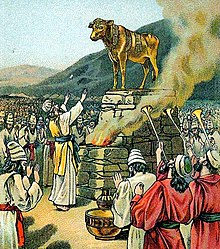
For a long while I've been ruminating on the nature of the Liturgy, Scripture as found in the Mass Propers, the Golden Calf narrative (thanks to Ratzinger's Spirit of the Liturgy), Good Friday tradition, and episcopal authority. Here are some semi-organized thoughts on the matter.
Nature of the Sacred Liturgy:
The Sacred Liturgy is Christ's eternal offering to the Father, in which we participate "through him, with him, and in him in the unity of the Holy Spirit": Christ makes the perfect sacrifice, and we configure ourselves to it through submission to his liturgical action as laid down by the Church—"without me you can do nothing" (John 15:5).
The Latin Rite, Scripture and its Nature, and the Mass Propers:
On paper, the Latin Rite Mass may well be the most explicitly Scriptural rite in all of Christendom. Scripture is not limited to the readings and psalms of the Liturgy of the Word. The Order of Mass itself is awash in Scripture. Moreover, the proper texts of the Mass—most neglected during the Processions of the Mass—come from the psalms, Old and New Testament canticles, and Gospel/Epistle passages. (Non-Scriptural proper texts are insignificant in number compared to the vast array of Scripture intended to be sung—and even these non-Scriptural texts are in most cases to be paired with verses from Scripture when possible.)
What does Jesus sing? Psalms were sung perfectly by Christ to the Heavenly Father during his earthly life as the perfect Jew, making the perfect sacrifice to the Father by following the Law perfectly in every way (Matthew 5:17). As Christ is the Eternal Word (John 1:1), the words he utters are a touchstone to eternity; they echo forever. Therefore, when the Propers are sung, Christ sings—I tell my choirs that singing Scripture allows for a "communion" of sorts even before they receive his Body, Blood, Soul and Divinity; "they do not sing, but Christ sings through them" (cf. Galatians 2:20).
Liturgical Norms: GIRM (I use the US edition since this is where I live), via the examples given in the ritual books cited, calls for Scripture to be sung at the three processions of the Mass (GIRM 48, 74, 87):
Golden Calf, Good Friday, and neglect/abuse of episcopal authority in the liturgy:
The Golden Calf and GIRM Option 4: Aaron the high priest fashioned the calf from the contributions of the people, at the behest of the people (Exodus 32:1–6). God did not approve this; in fact he hated it to the point of eradicating his chosen people (Exodus 32:7–10); but the people may well have led themselves to believe that Aaron's command was divine (neglect of priestly authority, i.e., "Aaron allowed us to do it, so it must be right"). Ratzinger observes that the people may have believed they were truly worshiping God, though of course they were not (Spirit of the Liturgy 22–23). When Moses confronts Aaron about the abuse he committed, Aaron heaps more sin upon his misdeed by being disingenous ("I cast it into the fire, and this calf came out", cf. Exodus 32:24). The rest of Exodus 32 outlines the grave consequences of this error.
In the United States, Option 4 allows "another suitable liturgical song" approved by the bishops. Despite many suitable liturgical songs from the treasury of the Church's liturgy (hymns of the Liturgy of the Hours, Sequences, Litanies, Responsories, etc.), many songbooks intended for use in the liturgy and "printed with ecclesiastical approval" include texts of questionable merit. The people in this instance believe they are worshipping God in spirit and truth, but is that the case? People are developing an attachment to these words, but are the words of Christ?
Good Friday and Option 4: Barabbas means "Son of the father"; tradition tells us that his first name also was Jesus (i.e., "God saves"). The mob, incited by the high priests and scribes, chose Barabbas—a savior of their own imagining—to be released instead of the true Savior, the Son of the Eternal Father. With the new Mass, Option 4 allows the Word of God (Options 1–3) to be cast aside for words of people's own choosing. In doing so, do we not unwittingly repeat Good Friday, in that we choose the words of man over the Word of God living and effective (Hebrews 4:12)?
At least with the Responsorial Psalm there is clearly delineated demand for Scripture: "Nor is it lawful to replace the readings and Responsorial Psalm, which contain the Word of God, with other, non-biblical texts" (GIRM 57). But the Church also demands Scripture be retained for the processional chants of the Mass (Sacrosanctum Concilium 116).
Episcopal Authority: Until the bishops speak and act in one voice on the matter, calling for the restoration of the Word of God to God's own liturgy, individual bishops, priests, and laity sympathetic to the sung Mass, propers in their Gregorian/polyphonic genres, etc., are stuck with "more Catholic than the Pope" accusations, etc. The biological solution works on everyone, and for those unsympathetic to these genres, they too can play a "waiting game". How many people consider Benedict XVI's pontificate a blip on the radar?
GIRM Option 3, a "third way" back to Scriptural liturgy regardless of musical style
Sidestepping the style wars: Dr. Mahrt and others have made very persuasive arguments for music stylistically proper to liturgy. Despite the many advances that have been made in certain parishes, other parishes seem to be stuck in the style wars, with no end in sight. Still other parishes retain music repertoires that are heavily or exclusively influenced by popular secular styles. In many of these cases more headway might be made when energy is focused on the textual justification for propers/singing of Psalms at the processions. Msgr. Wadsworth of ICEL has proposed the unity of the Roman liturgy is in its texts (cf. 2010 CMAA Colloquium keynote).
Option 3 as a textual upgrade from Option 4 as popularly applied: An Option 3 solution—"a chant from another collection of Psalms and antiphons, approved by the Conference of Bishops or the Diocesan Bishop, including Psalms arranged in responsorial or metrical forms"—regardless of the musical style, would constitute a vast improvement over the Option 4 fare that passes for worship. Since selections from Option 3 have a greater guarantee of being Scriptural, they are more likely to allow access to singing with Christ to the Father rather than singing amongst ourselves.
Many Option 3 selections are well-known in some way: Many settings of Responsorial Psalms and their paraphrases are well-established staples of existing ensembles' and congregations' repertoires; therefore, using these at the Entrance, Offertory, and Communion would not constitute a wholesale discarding of repertoire, which in some cases has taken much effort to master. Other selections that can fall under Option 3, e.g., Hymn Tune Introits, are easily adapted to hymn tunes that exist in parish repertoire.
Textual upgrade, not stylistic downgrade: Since Gregorian chant is the sung prayer proper to the Roman Rite, Masses that incorporate the propers in this idiom should not be eliminated, nor should efforts to learn this repertoire be abandoned. However, in those environments where this is not feasible in any way, moving from Option 4 to Option 3 would foster throughout the Mystical Body of Christ a greater unity with him who makes his eternal song to the Father.
May be the only way forward in many places: Singing Scripture that is clearly identifiable as such would go a long way towards fostering true unity in the Church's liturgy—a unity centered on and in Jesus Christ, who alone makes the true sacrifice to our heavenly Father. In places that frown upon the Church's traditional ritual music, moving from non-Scriptural lyrics to Scriptural lyrics may be the only feasible transition at this time.
 |
| Worshiping God: you're doing it wrong |
Nature of the Sacred Liturgy:
The Sacred Liturgy is Christ's eternal offering to the Father, in which we participate "through him, with him, and in him in the unity of the Holy Spirit": Christ makes the perfect sacrifice, and we configure ourselves to it through submission to his liturgical action as laid down by the Church—"without me you can do nothing" (John 15:5).
The Latin Rite, Scripture and its Nature, and the Mass Propers:
On paper, the Latin Rite Mass may well be the most explicitly Scriptural rite in all of Christendom. Scripture is not limited to the readings and psalms of the Liturgy of the Word. The Order of Mass itself is awash in Scripture. Moreover, the proper texts of the Mass—most neglected during the Processions of the Mass—come from the psalms, Old and New Testament canticles, and Gospel/Epistle passages. (Non-Scriptural proper texts are insignificant in number compared to the vast array of Scripture intended to be sung—and even these non-Scriptural texts are in most cases to be paired with verses from Scripture when possible.)
What does Jesus sing? Psalms were sung perfectly by Christ to the Heavenly Father during his earthly life as the perfect Jew, making the perfect sacrifice to the Father by following the Law perfectly in every way (Matthew 5:17). As Christ is the Eternal Word (John 1:1), the words he utters are a touchstone to eternity; they echo forever. Therefore, when the Propers are sung, Christ sings—I tell my choirs that singing Scripture allows for a "communion" of sorts even before they receive his Body, Blood, Soul and Divinity; "they do not sing, but Christ sings through them" (cf. Galatians 2:20).
Liturgical Norms: GIRM (I use the US edition since this is where I live), via the examples given in the ritual books cited, calls for Scripture to be sung at the three processions of the Mass (GIRM 48, 74, 87):
- Option 1 prescribes the Proper (Missal or Roman Gradual) — scriptural
- Option 2 prescribes the Proper (Simple Gradual) — scriptural
- Option 3 prescribes selections from other collections of Psalms and antiphons, provided they are approved by the bishops — scriptural
Golden Calf, Good Friday, and neglect/abuse of episcopal authority in the liturgy:
The Golden Calf and GIRM Option 4: Aaron the high priest fashioned the calf from the contributions of the people, at the behest of the people (Exodus 32:1–6). God did not approve this; in fact he hated it to the point of eradicating his chosen people (Exodus 32:7–10); but the people may well have led themselves to believe that Aaron's command was divine (neglect of priestly authority, i.e., "Aaron allowed us to do it, so it must be right"). Ratzinger observes that the people may have believed they were truly worshiping God, though of course they were not (Spirit of the Liturgy 22–23). When Moses confronts Aaron about the abuse he committed, Aaron heaps more sin upon his misdeed by being disingenous ("I cast it into the fire, and this calf came out", cf. Exodus 32:24). The rest of Exodus 32 outlines the grave consequences of this error.
In the United States, Option 4 allows "another suitable liturgical song" approved by the bishops. Despite many suitable liturgical songs from the treasury of the Church's liturgy (hymns of the Liturgy of the Hours, Sequences, Litanies, Responsories, etc.), many songbooks intended for use in the liturgy and "printed with ecclesiastical approval" include texts of questionable merit. The people in this instance believe they are worshipping God in spirit and truth, but is that the case? People are developing an attachment to these words, but are the words of Christ?
Good Friday and Option 4: Barabbas means "Son of the father"; tradition tells us that his first name also was Jesus (i.e., "God saves"). The mob, incited by the high priests and scribes, chose Barabbas—a savior of their own imagining—to be released instead of the true Savior, the Son of the Eternal Father. With the new Mass, Option 4 allows the Word of God (Options 1–3) to be cast aside for words of people's own choosing. In doing so, do we not unwittingly repeat Good Friday, in that we choose the words of man over the Word of God living and effective (Hebrews 4:12)?
At least with the Responsorial Psalm there is clearly delineated demand for Scripture: "Nor is it lawful to replace the readings and Responsorial Psalm, which contain the Word of God, with other, non-biblical texts" (GIRM 57). But the Church also demands Scripture be retained for the processional chants of the Mass (Sacrosanctum Concilium 116).
Episcopal Authority: Until the bishops speak and act in one voice on the matter, calling for the restoration of the Word of God to God's own liturgy, individual bishops, priests, and laity sympathetic to the sung Mass, propers in their Gregorian/polyphonic genres, etc., are stuck with "more Catholic than the Pope" accusations, etc. The biological solution works on everyone, and for those unsympathetic to these genres, they too can play a "waiting game". How many people consider Benedict XVI's pontificate a blip on the radar?
GIRM Option 3, a "third way" back to Scriptural liturgy regardless of musical style
Sidestepping the style wars: Dr. Mahrt and others have made very persuasive arguments for music stylistically proper to liturgy. Despite the many advances that have been made in certain parishes, other parishes seem to be stuck in the style wars, with no end in sight. Still other parishes retain music repertoires that are heavily or exclusively influenced by popular secular styles. In many of these cases more headway might be made when energy is focused on the textual justification for propers/singing of Psalms at the processions. Msgr. Wadsworth of ICEL has proposed the unity of the Roman liturgy is in its texts (cf. 2010 CMAA Colloquium keynote).
Option 3 as a textual upgrade from Option 4 as popularly applied: An Option 3 solution—"a chant from another collection of Psalms and antiphons, approved by the Conference of Bishops or the Diocesan Bishop, including Psalms arranged in responsorial or metrical forms"—regardless of the musical style, would constitute a vast improvement over the Option 4 fare that passes for worship. Since selections from Option 3 have a greater guarantee of being Scriptural, they are more likely to allow access to singing with Christ to the Father rather than singing amongst ourselves.
Many Option 3 selections are well-known in some way: Many settings of Responsorial Psalms and their paraphrases are well-established staples of existing ensembles' and congregations' repertoires; therefore, using these at the Entrance, Offertory, and Communion would not constitute a wholesale discarding of repertoire, which in some cases has taken much effort to master. Other selections that can fall under Option 3, e.g., Hymn Tune Introits, are easily adapted to hymn tunes that exist in parish repertoire.
Textual upgrade, not stylistic downgrade: Since Gregorian chant is the sung prayer proper to the Roman Rite, Masses that incorporate the propers in this idiom should not be eliminated, nor should efforts to learn this repertoire be abandoned. However, in those environments where this is not feasible in any way, moving from Option 4 to Option 3 would foster throughout the Mystical Body of Christ a greater unity with him who makes his eternal song to the Father.
May be the only way forward in many places: Singing Scripture that is clearly identifiable as such would go a long way towards fostering true unity in the Church's liturgy—a unity centered on and in Jesus Christ, who alone makes the true sacrifice to our heavenly Father. In places that frown upon the Church's traditional ritual music, moving from non-Scriptural lyrics to Scriptural lyrics may be the only feasible transition at this time.
Fr. Rick Heilman's 25th Anniversary Mass: Liturgical Notes
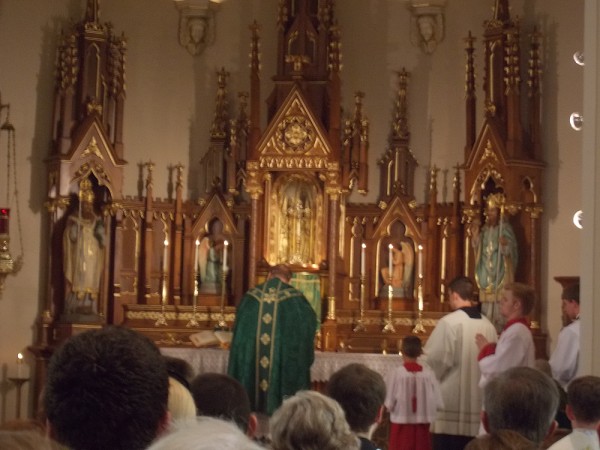 |
| Fr. Rick Heilman at the high altar of St. Mary's Pine Bluff, June 9, 2013 (photo: Elizabeth D/Lætificat Madison) |
Because Easter rarely falls as early as it did this year, the Mass celebrated was the rare 10th Sunday in Ordinary Time, Year C. All of the liturgical texts employed were of the day: there was no substitution of prayers, readings, or chants for others in the Missal, Lectionary, or Gradual that may have been considered appropriate or desirable. (As it turns out, every last assigned prayer, reading, and chant was quite appropriate for this Mass.) Everything was recited or sung in English unless indicated.
I should note that, other than the lack of an Entrance hymn, the addition of certain pieces at the Prelude and Communion, and the partially ad hoc choir, this is what currently passes for a typical Sunday Mass at Pine Bluff; the morning Mass for this day also featured choral singing from members of the parish choir.
Subscribe to:
Posts (Atom)