Showing posts with label Gregorian Chant. Show all posts

STrib profiles CMAA conference: Gregorian chants get a sacred encore and a showcase in St. Paul


via Chant Café
The Gregorian chant, best known as the solemn music sung by robed monks of old, is enjoying a 21st-century revival — and the Twin Cities are at the heart of it this week.

Experts and students of the ancient sacred music from across the globe have gathered for what is billed as “the most in-depth teaching conference ... on sacred music in the world.” They’re honing their musical skills and bringing the solemn choral notes to several St. Paul churches.

The centuries-old chants were tossed out of most Catholic churches after the Latin mass was put in deep storage in the 1960s. That was a mistake, say members of the Church Music Association of America, and a lot of people now recognize it.
continue at Star Tribune

Great EF Learning Opportunity in Elm Grove

The Musica Oramus choir and ministry, along with St. Mary's Visitation Parish and St. Stanislaus Oratory have joined together to offer a catechetical and prayer series helping people get a better understanding of the Extraordinary Form of the Holy Sacrifice of the Mass, along with the opportunity to pray the Traditional Mass.  The presentations begin at 2pm, with Mass at 3pm.  The first session has already passed but there are plenty more to come over the next several months.


Invites you to learn about and experience the beauty
of the Extraordinary Form of the Mass
on the following Sunday afternoons
at St. Mary’s Visitation Parish in Elm Grove:
October 16
October 30
February 19
March 5
Each session of this four part series begins at 2:00 p.m.
with Mass celebrated at 3:00 p.m.
(fulfills Sunday obligation)
The final session of the four part series (March 5)
will end with a dinner reception.
Presenters:
Father Peter Berger, Pastor of St. Mary’s Visitation Parish
Rev. Canon Benoît Jayr, Parish Administrator and
Rector of St. Stanislaus Oratory
  
"Let us generously open our hearts
and make room for everything that the faith itself allows."
Pope Benedict XVI from Summorum Pontificum

This series is open to the public but we ask that you please register
so that we can prepare accordingly.
Free will offerings accepted.
For more information or to register:
email info@musicaoramus.org or visit www.musicaoramus.org 

Dad29: The Chant Revolution in Milwaukee

Lo and behold!

Two western parishes in the Milwaukee Archdiocese have announced that they will launch Gregorian Chant choirs (scholae) beginning this Fall. Those would be St. Mary's (Visitation of the BVM) in Elm Grove and St. Jerome's in Oconomowoc.

It remains to be seen whether either will be successful, and what the programs will bring to the Masses in those parishes, of course.
continue at Dad29

Musicā Oramus Summer Workshop June 23rd in Elm Grove WI


I did want to mention that the choir group at my Parish, St. Mary's in Elm Grove, is holding a summer workshop on both the EF and OF.

This is open to anyone, I believe, at this point (even though the flier said originally teens - 30somethings). Many seemed interested. So if you wanted to share somewhere, that would be awesome. It looks like the fee is $50 to join in, but it is an entire day event to help people understand the EF, and in turn to help people understand the way the OF should be.
details at MusicaOramus

Fantastic video on The Monks of Norcia


HT LC

Their new album is on Amazon here: Benedicta: Marian Chant From Norcia

Update: Father Z notes they are looking for a Communications Director.  I think they have a Development Director working out of Iowa now.

The Program for next Sunday's 11:00 AM Mass at Our Lady of Guadalupe Shrine, La Crosse

…may be found here (PDF format). Those in the Marian Catechist Apostolate will be making/renewing their Solemn Consecration at this Mass, which will be celebrated by Cardinal Burke.

The Knights of Divine Mercy Schola Cantorum will be singing the proper chants for this Mass (in English), leading the Greek/Latin Ordinary, and singing a couple of harmonized Marian and Eucharistic hymns. This will be the Schola's 5th(?) year singing for the Marian Catechists' Mass at the Shrine.

Fr. Rick Heilman's 25th Anniversary Mass: Liturgical Notes

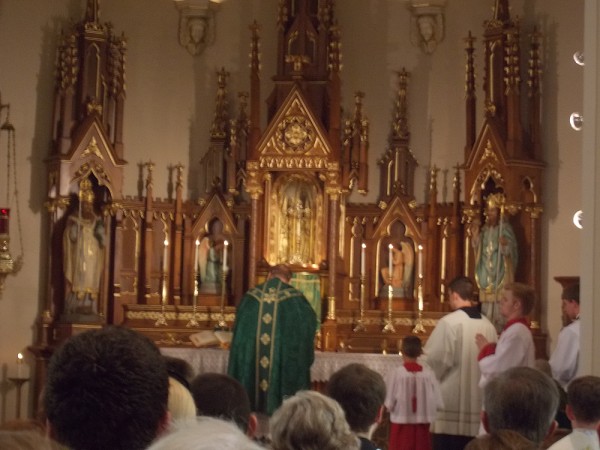
Fr. Rick Heilman at the high altar of
St. Mary's Pine Bluff, June 9, 2013
(photo: Elizabeth D/Lætificat Madison)
Steve posted earlier this week about the festivities surrounding the celebration of Fr. Rick Heilman's 25th Anniversary last Sunday; I thought it would be appropriate to talk about the celebration itself, that is, the Mass celebrated by Fr. Rick for this occasion.

Because Easter rarely falls as early as it did this year, the Mass celebrated was the rare 10th Sunday in Ordinary Time, Year C. All of the liturgical texts employed were of the day: there was no substitution of prayers, readings, or chants for others in the Missal, Lectionary, or Gradual that may have been considered appropriate or desirable. (As it turns out, every last assigned prayer, reading, and chant was quite appropriate for this Mass.) Everything was recited or sung in English unless indicated.

I should note that, other than the lack of an Entrance hymn, the addition of certain pieces at the Prelude and Communion, and the partially ad hoc choir, this is what currently passes for a typical Sunday Mass at Pine Bluff; the morning Mass for this day also featured choral singing from members of the parish choir.

But I grew up with hymns

Some emails I simply must share(question raised about those who want only hymns because that's all they know).  
Let me put it this way. You're preferring what some dude or dudette wrote about God, to singing with God? Jesus, the Word of God sang the Psalms, the Word of God, not what some dude or dudette wrote about Jesus. And Jesus chanted these Psalms (chant is the musical vehicle for Judaism to this day). Y U NO WANNA CHANT W/JESUS?
 
Liturgy is supposed to be an entrance into the life of the Trinitarian God. Not reduced to "I have reservations because I grew up with Liturgy being something entirely different."
For the record, I'm not against necessarily against hymns, just replacing the Mass with hymns.

Benedict XVI and an Incarnational Theology of Liturgical Music

Carolyn Pirtle, Assistant Director of the Notre Dame Center for Liturgy, offers a useful encapsulation of Benedict XVI's approach to the issue of liturgical music. An extended excerpt is below, with my emphases in boldface. Here is the full article.

"When people rightly call for a new dialogue between Church and culture today, they must not forget in the process that this dialogue must necessarily be bilateral. It cannot consist in the Church finally subjecting herself to modern culture… Just as the Church must expose herself to the problems of our age in a radically new way, so too must culture be questioned anew about its groundlessness and its ground, and in the process be opened to a painful cure, that is, to a new reconciliation with religion since it can get its lifeblood only from there. For this reason church music is really a very vital piece of a comprehensive task for our age which requires more than mere dialogue; it requires a process of rediscovering ourselves." —Joseph Ratzinger, A New Song to the Lord (1995), 95–6
For Ratzinger, this process of “rediscovering ourselves” necessitates a setting aside of the current debate surrounding liturgical music and the discussions it has generated (scholarly and otherwise). Doing so will facilitate a return to “the original source” in exploring connection between faith and music as well as the role of music in worship: the Bible. In turning to the Psalms in particular, Ratzinger establishes a theology of liturgical music in one verse: “Sing hymns of praise” (Ps 47:8, NRSV). True to his roots as a theologian who takes the biblical narrative seriously, Ratzinger engages this text in Hebrew, Greek, and Latin in order to arrive at a richer translation. Suffice it to say that singing hymns of praise well entails more than making pleasant-sounding music.

For the psalmist, offering sung praise to God implied singing with an understanding that surpasses mere rationality and transcends into the realm of sapientia, or wisdom, which “denotes an integration of the entire person who not only understands and is understandable from the perspective of pure thought, but with all the dimensions of his or her existence” (98). Ratzinger goes on to say that “there is an affinity between wisdom and music, since in it such an integration of humanness occurs and the entire person becomes a being in accordance with logos [with ‘reason’]” (98). It is in singing that the senses and the spirit are integrated into one being, and in singing to God that the being is incorporated into logos.

Christianity takes this understanding one step farther by understanding the Psalms not merely as hymns written by King David, but as hymns that “had risen from the heart of the real David, Christ” (97). Thus, singing “hymns of praise” not only harmonizes the senses with the spirit, but when Christians understand those hymns as having their source in Christ, they are also drawn out of themselves into harmony with the Logos, the Word-made-flesh, as they offer sung praise in and through Christ Himself. With this mindset, “Christ Himself becomes the choir director who teaches us the new song and gives the Church the tone and way in which she can praise God appropriately and blend into the heavenly liturgy” (97). In order to offer fitting praise, one must conform one’s song to that of Christ, “who did not regard equality with God as something to be grasped; rather, he emptied himself, taking the form of a slave” (Phil 2:6-7). [Read full article]


(HT: Adam Bartlett/ChantCafe.com)

An Ordinary-Form Missa Cantata…almost

Given the events that are taking place in the Church these days, I doubt that this post will receive much attention; however, as restoration of liturgical beauty has been a hallmark of Pope Benedict's papacy, mentioning the local impact of his leadership seems noteworthy.

Last Saturday marked the third consecutive time that I was asked to lead the Knights of Divine Mercy schola cantorum at the closing Mass of the Diocese of Madison's Men's Lenten Retreat. This year's Mass (an anticipated Mass for the Second Sunday of Lent) was as close as it has been to the Missa Cantata, the Sung Mass so desired by the Church to be the norm in the Latin Rite but so exceptionally rare in practice, especially in the Ordinary Form.[1] The Mass, which was celebrated by Msgr. James Bartylla,[2] the Vicar General of the Diocese of Madison, was sung a cappella or said in English unless otherwise specified:
  • Introductory Rites
    • Entrance Procession and Incensation of the Altar (Psalm 25: 6, 3, 22; 1–3; Glory Be; Simple English Propers, pp. 64–65): sung by the schola cantorum
    • Sign of the Cross: Missal, solemn tone
    • Greeting "Grace and peace…": Missal, solemn tone
    • Penitential Act "Have mercy on us, O Lord…": Missal, solemn tone
    • Kyrie: Mass XVI, Greek, sung by all
    • Collect[3]: Missal, solemn tone
  • Liturgy of the Word
    • First Reading (Gen 15: 5–12, 17–18): Missal tone for the first reading, sung by a server/reader
    • Responsorial Psalm (cf. Ps 27: 1a, Modal Responsorial Psalms, p. 39): sung by psalmist; response sung by all.[4]
    • Second Reading (Phil 3: 17–4: 1): Missal tone for the second reading, sung by another server/reader
    • Gospel Acclamation ("Praise to you, Lord Jesus Christ…", Modal Responsorial Psalms, p. 39): led by cantor; response sung by all
    • Gospel (Lk 9: 28b–36): Missal, simple tone, sung by the Priest
    • Homily: spoken (of course!)
    • Creed: spoken (the Missal provides two melodies)
    • Prayer of the Faithful: spoken (the Missal provides four melodic formulas)
  • Liturgy of the Eucharist
    • Preparation of the Offerings and Incensation (Psalm 119: 47, 48; Psalm 119; Simple English Propers, pp. 65–66): sung by the schola cantorum
    • Invitation to Prayer "Pray, brethren, that my sacrifice": Missal, solemn tone
    • Prayer over the Offerings: Missal, solemn tone
    • Preface: Missal tone
    • Sanctus: Mass XVIII, Latin, sung by all
    • Eucharistic Prayer II: Missal tone
    • Mystery of Faith "Save us, Savior of the world…": Missal tone
    • Doxology: Missal, solemn tone
  • Communion Rite
    • Lord's Prayer: Missal tone for the Dioceses of the United States
    • Embolism and Doxology: Missal tone
    • Sign of Peace: Missal tone
    • Agnus Dei: Mass XVIII, Latin, sung by all
    • "Behold the Lamb of God" dialog: Missal tone
    • Communion Chant I (Matthew 17:9; Psalm 45; Simple English Propers, pp. 66–67): sung by the schola cantorum; Latin Gregorian antiphon sung by a solo cantor
    • Communion Chant II (John 6:51a; Psalm 23; English chant derived from the Latin original found in the Graduale Simplex): sung by a solo cantor
    • Prayer after Communion: Missal, solemn tone
  • Concluding Rites
    • Blessing: Missal, solemn tone
    • Dismissal "Go and announce…": Missal tone
  • Hymn: "What Wondrous Love is This"
This year the schola cantorum was spread rather thinly, as only four men including myself were able to chant; others in the group were called to serve at the altar.

I think moving towards actually enacting what the Church asks in regard to the singing of the words of the Mass instead of relegating it to a printed book ought to be a primary objective, given the Year of Faith theme for our diocese: "Evangelization through Beauty".[5]

[1] "For the celebration of the Eucharist with the people, especially on Sundays and feast days, a form of sung Mass (Missa in cantu) is to be preferred as much as possible, even several times on the same day." Musicam Sacram Instruction on Music in the Liturgy, ¶27, emphasis added. Although some may argue that this instruction doesn't apply to the current revision of the English-language Roman Missal, in fact the 2010 revision provides almost all of the resources needed for the priest to sing: the parts of the Mass proper to himself; many of the parts he sings with the faithful, e.g., the Sanctus; and the parts of the Mass that are better delegated to others, e.g., lector.

[2] From September to May as his schedule allows, Msgr. Bartylla celebrates a Latin Missa Cantata with Gregorian chant and vernacular readings on the first Tuesday of each month at noon; he celebrates an English Missa Cantata with Gregorian-inspired English plainsong on the third Tuesday of the month at noon. In the case of a scheduling conflict these Masses are usually transferred to the following Tuesday. All of these Masses take in the chapel of the Bishop O'Connor Catholic Pastoral Center [map].

[3] Why this was ever called the "Opening Prayer" in the defunct English translation mystifies me. Does not prayer occur from the beginning of the Mass? It's more logical to understand the Collect as the closing prayer of the Introductory Rites.

[4] "Faith comes from hearing." Thus, I propose that during the Responsorial Psalm and other liturgical texts that share its nature, audible cues—such as slowing down at the final line of a verse and maintaining a consistent breathing pattern—are better than visual cues at fostering actual participation, i.e., intentional listening and prayerful singing. No visual cues were used to prompt the people's singing of the refrain other than psalmist's looking up from the ambo, which was done in conjunction with the aforementioned audible cues.

[5] A friend recently relayed to me a question asked of her by another friend regarding the difference between the High Mass and the Low Mass (within the context of the Extraordinary Form). I quipped: At High Mass, all the texts that are supposed to be uttered in song are sung. At Low Mass, all the texts that are supposed to be uttered in song are…muttered. There are other differences to be sure, but given the weight Church teaching has placed on sacred music, I focus on that primarily. And the musical differences between High Mass and Low Mass also apply to the Ordinary Form of the Roman Rite regardless of whether it is celebrated in its sacral languages.

Wherein musical selections leave me dazed and confused

At least that's how I feel sometimes.  My former parish has an excellent music program.  But I'm not exactly sure how to explain this.  For Advent and Lent they sing the Gregorian propers, not just plainchant, but the real deal assigned for the season.  I LOVE IT. 


Notice even an adapted Memorial and Amen, well done
Now there is a Kyrie for Mass XVII but it is not used, still in Greek though
I know you are jealous

Now comes Christmas!
Well....
*SIIIIGH* feels like someone socked me with a missal

Wait, but the choir blow the roof off with an awesome Agnus Dei?
but then the following Sunday has moved back to English
So I'm not quite sure what the vision is.  There is such a stark contrast between the Gregorian Chant and English versions.  It seems like plainchant would be a middle ground if there was a hope to move in that direction.  Perhaps everyone, the English squatters and the Latin pushers(of which I was one of the few), get their way at some point during the year.  I don't know.  So I must say that singing the Gregorian chant through a penitential season and then not being able to rejoice with them at the pinnacle of said season is both disappointing and confusing; but only because it is so fresh in my mind what I could have had. 

There I said it.  If I am now censured or something you know why.

Archbishop-designate Sample's Pastoral Letter on Sacred Music

On January 21 of this year Bishop Alexander Sample of Marquette issued "Rejoice in the Lord Always," a pastoral letter on Sacred Music in Divine Worship, but the PDF of it was uploaded only this morning. (H/T to Adam Bartlett of the Chant Café.) You may download it directly from the Diocese of Marquette's website here.

What struck me the most about this letter is that it calls for the following:
  • Pastors and musicians to possess knowledge of the musical directives as found in Church documents (listed in the appendix) and to base preparations for liturgies on them;
  • An understanding that one prepares for the liturgy instead of plans it (subtle but important distinction);
  • At least one Sunday Mass per parish be a Sung Mass (missa cantata) according to the capabilities of the priest and faithful;
  • An awareness of the nonliturgical nature of the "Recessional Hymn", calling for an instrumental piece or silence (in Lent);
  • Moving toward the singing of the Proper of the Mass (Entrance/Offertory/Communion chants), while laying down tighter guidelines for hymn substitution of these Propers (which takes place on a widespread basis);
  • Weekday Masses to incorporate some liturgical singing;
  • All capable priests of the diocese to learn to pray the Roman Canon in chant according to the tones in the Missal;
  • All parishes to learn two chant Mass settings (VIII and XVIII);
  • All parishes to conduct Triduum liturgies a cappella from the Gloria of Holy Thursday until the Gloria of the Easter Vigil.
He is set to leave the Marquette Diocese in a couple of months, so I'm unsure how well, how quickly, or if the directives in this Pastoral Letter will be implemented. (I have read some positive reports from last June's Diocesan Sacred Music Conference, and I understand that he has recently hired a music director to carry out some of the above at the cathedral there.) However, as he will be installed as archbishop of Portland, Oregon on April 2 his presence may very well begin to be felt (albeit indirectly) not only in the churches of the Diocese of Marquette but also in all churches that use materials published by Oregon Catholic Press. (He is also the incoming chairman of OCP by reason of his archbishopric.)

In any case, it's extremely refreshing to see the chief liturgist of a diocese teach and issue directives about the sacred liturgy that are in continuity with Church teaching. May their number increase.

And readers aware of the Proper of the Mass know that the beginning of the Entrance Antiphon for the Third Sunday of Advent is used for the title of this pastoral letter.

More analysis available at WDTPRS.

Benedictine College choir performs in La Crosse area this weekend

St. Gregory the Great Choir from Benedictine College in Atchison, Kansas (directed by Christian Ryan) will be performing a concert at the Cathedral of the Sacred Heart (360 Main Street) in Winona, Minnesota on Saturday, February 16th at 2 P.M. The choir, which specializes in sacred polyphony and Gregorian chant, will be performing works by Palestrina, Tallis, Stainer, Victoria, Arcadelt, and other Polyphonic composers. The concert is free, although there is a requested donation of $5. Please join us in Winona and listen to the great music of the Church!

The St. Gregory the Great Choir will also sing at the 9:30 a.m. Traditional Latin Mass at the Shrine of Our Lady of Guadalupe in La Crosse for the First Sunday in Lent, February 17th. Come experience the beauty of the Extraordinary Form of the Roman Rite Mass with Sacred Music composed for the Sacred Liturgy!

Abp. Sample: We need to sing the Mass

"It is clear that the Council calls for the liturgy to be sung. In recent decades we’ve adopted the practice of singing songs at Mass. We take the Mass, and attach four hymns or songs to it. But this is not the Church’s vision. We need to sing the Mass. It is meant to be sung. The texts of the Mass are meant to be sung.

"The Church provides us with chant, which is integral to liturgy, and should inspire the music of the Mass. We need to get away from singing songs at Mass and return to singing the Mass… It will be a huge shift for the people."


Catholic World Report

Photo

HT Aristotle 

The Place of the Propers in Liturgical Prayer

This is a talk given by Christopher Carstens, the Director of Sacred Worship for the La Crosse Diocese, at the recent Chant Workshop at St. James in La Crosse.

Here is a copy of the handout that he references.

"Chant isn’t just for the old Mass"

Lawrence Stich, the director of the Holy Redeemer Schola Cantorum, kindly granted me an email interview–a first for my blog, and I hope to do some more interviews. The Schola sings Greogrian chant about twice a month for our 7am Sunday Traditional Latin Mass, including this Sunday, Nov 25th. They welcome new members, and no prior choir experience is required. Leave a comment or use the “Contact” link at the top of the page if you would like me to put you in touch with Larry. Increasing hunger for truly beautiful, truly Catholic music is reflected in this recent rave review of Larry’s music for a Solemn High Wedding Mass at St Stanislaus in Milwaukee. 
 

Chant isn’t just for the old Mass. Larry is also now preparing a choir at St Patrick parish in Cottage Grove, for the Novus Ordo Mass. West of Madison, Fr Rick Heilman’s parish St Mary of Pine Bluff has wonderful chant in Latin and in English under the skilled direction of Aristotle Esguerra.

Larry, thank you for letting me interview you. Can you first tell something about yourself and your long history as a church musician?

Liz, I’ll begin a bit earlier—I was an altar boy when the Extraordinary Form was still in regular use. As to the music part, after several years of piano instruction I was privileged to study organ under Sr. Mary Theophane (Hytrek) OSF at Alverno College, and began as an organist at about that time. That was in the early 1960’s. When the next parish over needed a choir-accompanist/organist, I took the position (they paid for my services!) After a few years, I was asked to become the choir director, too. Most of that work was done in the “New Rite”—today’s Ordinary Form– although we continued to use Latin music about 10-20% of the time. After 20 years there, the Pastor retired. I was married and we lived on the opposite side of Milwaukee from that parish, so I took a similar position with a Parish closer to our home. In that assignment, I had a wonderful organist/accompanist—a Ph.D. nuclear engineer, by the way—who was the first person to petition for an Indult “Old Rite” Mass in Milwaukee. When that petition was granted by Abp. Weakland[!], I was asked to become the choir director for the Old Rite Mass. That was actually my first experience with Chan propers.
continue at Laetificat

This fellow sounds like he knows what he's talking about.

Chant & Polyphony workshop in La Crosse October 19-20

Gregorian Chant & Polyphony Sacred Music Workshop

October 19-20, 2012

Hosted by Saint James the Less Catholic Church
1032 Caledonia Street
La Crosse, WI 54603

Patrick Burkhart lead choir singing in Rome at St. Peter's Basilica
Advanced Chant with Aristotle Esguerra
Music Director at the Catholic Churches of St. Ignatius, Mount Horeb, WI
and St. Mary in Pine Bluff, WI.
Beginning Chant with Patrick Burkhart
Director of Sacred Music, St. James the Less Catholic Church, La Crosse, WI.
The Propers in Liturgical Prayer with Christopher Carstens
Director of Sacred Worship for the Diocese of La Crosse


3:00 P.M.……………………..Registration
3:30 P.M....The Place of the Propers in Liturgical Prayer
4:00 P.M……………………...Session One
5:00 P.M………………..Choral Rehearsal
6:00 P.M…………...Dinner On Your Own
Saturday, October 20
7:30 A.M……………………….Holy Mass
8:00 A.M…………..Continental breakfast
9:00 A.M……………………Session Three
10:30 A. M…………………...Session Four
12:00 P.M. …………………………Lunch
1:00 P.M.…………………......Session Five
2:30 P.M……………………….Session Six
3:30 P.M………………..Choral Rehearsal
4:30 P.M………………………..Holy Mass

Participants will:
 Become more familiar with the church’s rich patrimony of Gregorian Chant
Learn practical ways to introduce chant into their own parishes
Conclude the workshop singing the Proper and Ordinary Chants for Sunday Mass

Chant Workshop details [pdf]

Madison Youth petition for better liturgical music at Youth Retreat

We're all smiles after someone smashes your guitar
As you might know, many have attended the Youth 2000 retreats since they began here in Madison in 2009. Thank you for all of the work that you have put into these retreats.

But as you also may know, one of the frustrations that many have stems from the music used during the weekend. It seems quite clear that the church consistently asks us for something higher, something more reverent than rock music during the Holy Mass (rock music is being used in a more general sense, for the sake of this discussion).

Of course, this is not a new problem. For example, in 1905, Pope Pius X covered nearly the same issue:

“[2.] It must be holy, and therefore avoid everything that is secular, both in itself and in the way in which it is performed. It must really be an art, since in no other way can it have on the mind of those who hear it that effect which the Church desires in using in her liturgy the art of sound.


“But it must also be universal in this sense, namely, that although each country may use in its ecclesiastical music whatever special forms may belong to its own national style, these forms must be subject to the proper nature of sacred music, so that it may never produce a bad impression on the mind of any stranger who may hear it.”
—Tra Le Sollecitudini, 1905
 continue and sign the petition at Yankehome

HT BY