
Showing posts with label Sacred Music. Show all posts
Showing posts with label Sacred Music. Show all posts

Mozart's 'Requiem' at St. Josaphat's March 31-April 2
The Milwaukee Symphony Orchestra and Chorus say to expect
"A profoundly affecting concert experience, in the magnificence of the Basilica of St. Josaphat."On the music, Elaine Schmidt wrote on "Separating truth about Mozart's 'Requiem' from the legends" in the Milwaukee Journal Sentinel.
In case you've never visited the venue, here's more about The Basilica.
Great EF Learning Opportunity in Elm Grove
The Musica Oramus choir and ministry, along with St. Mary's Visitation Parish and St. Stanislaus Oratory have joined together to offer a catechetical and prayer series helping people get a better understanding of the Extraordinary Form of the Holy Sacrifice of the Mass, along with the opportunity to pray the Traditional Mass. The presentations begin at 2pm, with Mass at 3pm. The first session has already passed but there are plenty more to come over the next several months.

October 16

Invites you to learn about and experience the beauty
of the Extraordinary Form of the Mass
on the following Sunday afternoons
at St. Mary’s Visitation Parish in Elm Grove:
October 30
February 19
March 5
Each session of this four part series begins at 2:00 p.m.
with Mass celebrated at 3:00 p.m.
(fulfills Sunday obligation)
The final session of the four part series (March 5)
will end with a dinner reception.
Presenters:
Father Peter Berger, Pastor of St. Mary’s Visitation Parish
Rev. Canon Benoît Jayr, Parish Administrator and
Rector of St. Stanislaus Oratory
"Let us generously open our hearts
and make room for everything that the faith itself allows."
Pope Benedict XVI from Summorum Pontificum
This series is open to the public but we ask that you please register
so that we can prepare accordingly.
Free will offerings accepted.
For more information or to register:
email info@musicaoramus.org or visit www.musicaoramus.org
Video from Guadalupe Shrine Festival of Sacred Music: Amazing!
This is in the votive chapel on the way up to the church.
HT SD
HT SD
ChantCafe: Let's Revisit "Praise and Worship Music is Praise But Not Worship"
continue at Chant CaféMost articles in the blogosphere have a very short shelf life, which is why I am quite surprised that an article I posted on Chant Café on 2 June 2011 keeps reappearing on blogs and in my social media newsfeeds every so often. Why Praise and Worship Music is Praise and Not Worship seems to keep being resurrected, which I can only surmise because the discussion it continues to elicit is still quite relevant, and the questions it raises have not been answered to everyone’s satisfaction. What’s more, following the comments on social media on the article has been very interesting, and I think telling about where we are now with regards to the situation of praise and worship music in liturgy. Perhaps a revisit is in order.
The article has three main components. In the first part, I share my own experience with a particular use of praise and worship, the Lifeteen Mass, which was twenty years ago now, and how it caused me to reflect at the time and now on its appropriateness for the sacred liturgy. What I have found most interesting is that the most negative reactions I have come across to the article tend to parse this first section and then ignore the other two. My response to this is the following: My experience is obviously not going to be the experience of everyone; some will resonate with that experience and others will not. That’s why it is a personal reflection. I am delighted to read that there are those who have not had anything like the experience that I had with Lifeteen. I am also dismayed to read that, twenty years later, some people are having exactly the same experience I have had. I am told that the organization Lifeteen itself has repudiated many of the abusive liturgical practices which made my exposure to it so distressing, and that the guidance of Bishop Olmsted of Phoenix has been exemplary in this regard. I rejoice that this is the case. Surely it is in some way testimony to how Pope Emeritus Benedict XVI’s rich theology of the liturgy is finding its way into the Church’s life. I am also aware that there are a significant number of priests, seminarians and committed young lay faithful who credit Lifeteen and similar initiatives as powerful in their formation as Catholics. All of that is to the good. And none of that invalidates my experience, any more than it invalidates the experience of those whose history with these initiatives is entirely different than my own.

WisSJ: As number of church organists declines, fears of a dying art
Read more: http://host.madison.com/lifestyles/faith-and-values/religion/in-the-spirit-as-number-of-church-organists-declines-fears/article_2ff84d43-7eca-540c-bff1-339da5122335.html#ixzz3DPGSK0L6A vicious circle is playing out across the religious landscape, to hear church musicians tell of it.
Fewer young people are studying the organ, which has led some churches to remove the instrument for lack of practitioners. And without the physical presence of an organ to spark interest, even fewer young people are considering the possibility of learning to play it.
As Patrick Gorman, president of the Madison Association of Church Musicians, put it: “The art of organ playing is dying.”
While that assessment might seem dire, Gorman said all is not lost, and the group he heads is trying to be part of the solution. At 7:30 p.m. Sept. 26, the association will present an organ recital featuring nine area organists at Our Savior’s Lutheran Church, 550 Lincoln Drive, Sun Prairie.

The Program for next Sunday's 11:00 AM Mass at Our Lady of Guadalupe Shrine, La Crosse
…may be found here (PDF format). Those in the Marian Catechist Apostolate will be making/renewing their Solemn Consecration at this Mass, which will be celebrated by Cardinal Burke.
The Knights of Divine Mercy Schola Cantorum will be singing the proper chants for this Mass (in English), leading the Greek/Latin Ordinary, and singing a couple of harmonized Marian and Eucharistic hymns. This will be the Schola's 5th(?) year singing for the Marian Catechists' Mass at the Shrine.
The Knights of Divine Mercy Schola Cantorum will be singing the proper chants for this Mass (in English), leading the Greek/Latin Ordinary, and singing a couple of harmonized Marian and Eucharistic hymns. This will be the Schola's 5th(?) year singing for the Marian Catechists' Mass at the Shrine.
Singing Scripture throughout Mass: Why We Must and How We Might
(Reposted from Corpus Christi Watershed)
For a long while I've been ruminating on the nature of the Liturgy, Scripture as found in the Mass Propers, the Golden Calf narrative (thanks to Ratzinger's Spirit of the Liturgy), Good Friday tradition, and episcopal authority. Here are some semi-organized thoughts on the matter.
Nature of the Sacred Liturgy:
The Sacred Liturgy is Christ's eternal offering to the Father, in which we participate "through him, with him, and in him in the unity of the Holy Spirit": Christ makes the perfect sacrifice, and we configure ourselves to it through submission to his liturgical action as laid down by the Church—"without me you can do nothing" (John 15:5).
The Latin Rite, Scripture and its Nature, and the Mass Propers:
On paper, the Latin Rite Mass may well be the most explicitly Scriptural rite in all of Christendom. Scripture is not limited to the readings and psalms of the Liturgy of the Word. The Order of Mass itself is awash in Scripture. Moreover, the proper texts of the Mass—most neglected during the Processions of the Mass—come from the psalms, Old and New Testament canticles, and Gospel/Epistle passages. (Non-Scriptural proper texts are insignificant in number compared to the vast array of Scripture intended to be sung—and even these non-Scriptural texts are in most cases to be paired with verses from Scripture when possible.)
What does Jesus sing? Psalms were sung perfectly by Christ to the Heavenly Father during his earthly life as the perfect Jew, making the perfect sacrifice to the Father by following the Law perfectly in every way (Matthew 5:17). As Christ is the Eternal Word (John 1:1), the words he utters are a touchstone to eternity; they echo forever. Therefore, when the Propers are sung, Christ sings—I tell my choirs that singing Scripture allows for a "communion" of sorts even before they receive his Body, Blood, Soul and Divinity; "they do not sing, but Christ sings through them" (cf. Galatians 2:20).
Liturgical Norms: GIRM (I use the US edition since this is where I live), via the examples given in the ritual books cited, calls for Scripture to be sung at the three processions of the Mass (GIRM 48, 74, 87):
Golden Calf, Good Friday, and neglect/abuse of episcopal authority in the liturgy:
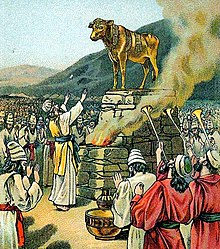
The Golden Calf and GIRM Option 4: Aaron the high priest fashioned the calf from the contributions of the people, at the behest of the people (Exodus 32:1–6). God did not approve this; in fact he hated it to the point of eradicating his chosen people (Exodus 32:7–10); but the people may well have led themselves to believe that Aaron's command was divine (neglect of priestly authority, i.e., "Aaron allowed us to do it, so it must be right"). Ratzinger observes that the people may have believed they were truly worshiping God, though of course they were not (Spirit of the Liturgy 22–23). When Moses confronts Aaron about the abuse he committed, Aaron heaps more sin upon his misdeed by being disingenous ("I cast it into the fire, and this calf came out", cf. Exodus 32:24). The rest of Exodus 32 outlines the grave consequences of this error.
In the United States, Option 4 allows "another suitable liturgical song" approved by the bishops. Despite many suitable liturgical songs from the treasury of the Church's liturgy (hymns of the Liturgy of the Hours, Sequences, Litanies, Responsories, etc.), many songbooks intended for use in the liturgy and "printed with ecclesiastical approval" include texts of questionable merit. The people in this instance believe they are worshipping God in spirit and truth, but is that the case? People are developing an attachment to these words, but are the words of Christ?
Good Friday and Option 4: Barabbas means "Son of the father"; tradition tells us that his first name also was Jesus (i.e., "God saves"). The mob, incited by the high priests and scribes, chose Barabbas—a savior of their own imagining—to be released instead of the true Savior, the Son of the Eternal Father. With the new Mass, Option 4 allows the Word of God (Options 1–3) to be cast aside for words of people's own choosing. In doing so, do we not unwittingly repeat Good Friday, in that we choose the words of man over the Word of God living and effective (Hebrews 4:12)?
At least with the Responsorial Psalm there is clearly delineated demand for Scripture: "Nor is it lawful to replace the readings and Responsorial Psalm, which contain the Word of God, with other, non-biblical texts" (GIRM 57). But the Church also demands Scripture be retained for the processional chants of the Mass (Sacrosanctum Concilium 116).
Episcopal Authority: Until the bishops speak and act in one voice on the matter, calling for the restoration of the Word of God to God's own liturgy, individual bishops, priests, and laity sympathetic to the sung Mass, propers in their Gregorian/polyphonic genres, etc., are stuck with "more Catholic than the Pope" accusations, etc. The biological solution works on everyone, and for those unsympathetic to these genres, they too can play a "waiting game". How many people consider Benedict XVI's pontificate a blip on the radar?
GIRM Option 3, a "third way" back to Scriptural liturgy regardless of musical style
Sidestepping the style wars: Dr. Mahrt and others have made very persuasive arguments for music stylistically proper to liturgy. Despite the many advances that have been made in certain parishes, other parishes seem to be stuck in the style wars, with no end in sight. Still other parishes retain music repertoires that are heavily or exclusively influenced by popular secular styles. In many of these cases more headway might be made when energy is focused on the textual justification for propers/singing of Psalms at the processions. Msgr. Wadsworth of ICEL has proposed the unity of the Roman liturgy is in its texts (cf. 2010 CMAA Colloquium keynote).
Option 3 as a textual upgrade from Option 4 as popularly applied: An Option 3 solution—"a chant from another collection of Psalms and antiphons, approved by the Conference of Bishops or the Diocesan Bishop, including Psalms arranged in responsorial or metrical forms"—regardless of the musical style, would constitute a vast improvement over the Option 4 fare that passes for worship. Since selections from Option 3 have a greater guarantee of being Scriptural, they are more likely to allow access to singing with Christ to the Father rather than singing amongst ourselves.
Many Option 3 selections are well-known in some way: Many settings of Responsorial Psalms and their paraphrases are well-established staples of existing ensembles' and congregations' repertoires; therefore, using these at the Entrance, Offertory, and Communion would not constitute a wholesale discarding of repertoire, which in some cases has taken much effort to master. Other selections that can fall under Option 3, e.g., Hymn Tune Introits, are easily adapted to hymn tunes that exist in parish repertoire.
Textual upgrade, not stylistic downgrade: Since Gregorian chant is the sung prayer proper to the Roman Rite, Masses that incorporate the propers in this idiom should not be eliminated, nor should efforts to learn this repertoire be abandoned. However, in those environments where this is not feasible in any way, moving from Option 4 to Option 3 would foster throughout the Mystical Body of Christ a greater unity with him who makes his eternal song to the Father.
May be the only way forward in many places: Singing Scripture that is clearly identifiable as such would go a long way towards fostering true unity in the Church's liturgy—a unity centered on and in Jesus Christ, who alone makes the true sacrifice to our heavenly Father. In places that frown upon the Church's traditional ritual music, moving from non-Scriptural lyrics to Scriptural lyrics may be the only feasible transition at this time.
 |
| Worshiping God: you're doing it wrong |
Nature of the Sacred Liturgy:
The Sacred Liturgy is Christ's eternal offering to the Father, in which we participate "through him, with him, and in him in the unity of the Holy Spirit": Christ makes the perfect sacrifice, and we configure ourselves to it through submission to his liturgical action as laid down by the Church—"without me you can do nothing" (John 15:5).
The Latin Rite, Scripture and its Nature, and the Mass Propers:
On paper, the Latin Rite Mass may well be the most explicitly Scriptural rite in all of Christendom. Scripture is not limited to the readings and psalms of the Liturgy of the Word. The Order of Mass itself is awash in Scripture. Moreover, the proper texts of the Mass—most neglected during the Processions of the Mass—come from the psalms, Old and New Testament canticles, and Gospel/Epistle passages. (Non-Scriptural proper texts are insignificant in number compared to the vast array of Scripture intended to be sung—and even these non-Scriptural texts are in most cases to be paired with verses from Scripture when possible.)
What does Jesus sing? Psalms were sung perfectly by Christ to the Heavenly Father during his earthly life as the perfect Jew, making the perfect sacrifice to the Father by following the Law perfectly in every way (Matthew 5:17). As Christ is the Eternal Word (John 1:1), the words he utters are a touchstone to eternity; they echo forever. Therefore, when the Propers are sung, Christ sings—I tell my choirs that singing Scripture allows for a "communion" of sorts even before they receive his Body, Blood, Soul and Divinity; "they do not sing, but Christ sings through them" (cf. Galatians 2:20).
Liturgical Norms: GIRM (I use the US edition since this is where I live), via the examples given in the ritual books cited, calls for Scripture to be sung at the three processions of the Mass (GIRM 48, 74, 87):
- Option 1 prescribes the Proper (Missal or Roman Gradual) — scriptural
- Option 2 prescribes the Proper (Simple Gradual) — scriptural
- Option 3 prescribes selections from other collections of Psalms and antiphons, provided they are approved by the bishops — scriptural
Golden Calf, Good Friday, and neglect/abuse of episcopal authority in the liturgy:
The Golden Calf and GIRM Option 4: Aaron the high priest fashioned the calf from the contributions of the people, at the behest of the people (Exodus 32:1–6). God did not approve this; in fact he hated it to the point of eradicating his chosen people (Exodus 32:7–10); but the people may well have led themselves to believe that Aaron's command was divine (neglect of priestly authority, i.e., "Aaron allowed us to do it, so it must be right"). Ratzinger observes that the people may have believed they were truly worshiping God, though of course they were not (Spirit of the Liturgy 22–23). When Moses confronts Aaron about the abuse he committed, Aaron heaps more sin upon his misdeed by being disingenous ("I cast it into the fire, and this calf came out", cf. Exodus 32:24). The rest of Exodus 32 outlines the grave consequences of this error.
In the United States, Option 4 allows "another suitable liturgical song" approved by the bishops. Despite many suitable liturgical songs from the treasury of the Church's liturgy (hymns of the Liturgy of the Hours, Sequences, Litanies, Responsories, etc.), many songbooks intended for use in the liturgy and "printed with ecclesiastical approval" include texts of questionable merit. The people in this instance believe they are worshipping God in spirit and truth, but is that the case? People are developing an attachment to these words, but are the words of Christ?
Good Friday and Option 4: Barabbas means "Son of the father"; tradition tells us that his first name also was Jesus (i.e., "God saves"). The mob, incited by the high priests and scribes, chose Barabbas—a savior of their own imagining—to be released instead of the true Savior, the Son of the Eternal Father. With the new Mass, Option 4 allows the Word of God (Options 1–3) to be cast aside for words of people's own choosing. In doing so, do we not unwittingly repeat Good Friday, in that we choose the words of man over the Word of God living and effective (Hebrews 4:12)?
At least with the Responsorial Psalm there is clearly delineated demand for Scripture: "Nor is it lawful to replace the readings and Responsorial Psalm, which contain the Word of God, with other, non-biblical texts" (GIRM 57). But the Church also demands Scripture be retained for the processional chants of the Mass (Sacrosanctum Concilium 116).
Episcopal Authority: Until the bishops speak and act in one voice on the matter, calling for the restoration of the Word of God to God's own liturgy, individual bishops, priests, and laity sympathetic to the sung Mass, propers in their Gregorian/polyphonic genres, etc., are stuck with "more Catholic than the Pope" accusations, etc. The biological solution works on everyone, and for those unsympathetic to these genres, they too can play a "waiting game". How many people consider Benedict XVI's pontificate a blip on the radar?
GIRM Option 3, a "third way" back to Scriptural liturgy regardless of musical style
Sidestepping the style wars: Dr. Mahrt and others have made very persuasive arguments for music stylistically proper to liturgy. Despite the many advances that have been made in certain parishes, other parishes seem to be stuck in the style wars, with no end in sight. Still other parishes retain music repertoires that are heavily or exclusively influenced by popular secular styles. In many of these cases more headway might be made when energy is focused on the textual justification for propers/singing of Psalms at the processions. Msgr. Wadsworth of ICEL has proposed the unity of the Roman liturgy is in its texts (cf. 2010 CMAA Colloquium keynote).
Option 3 as a textual upgrade from Option 4 as popularly applied: An Option 3 solution—"a chant from another collection of Psalms and antiphons, approved by the Conference of Bishops or the Diocesan Bishop, including Psalms arranged in responsorial or metrical forms"—regardless of the musical style, would constitute a vast improvement over the Option 4 fare that passes for worship. Since selections from Option 3 have a greater guarantee of being Scriptural, they are more likely to allow access to singing with Christ to the Father rather than singing amongst ourselves.
Many Option 3 selections are well-known in some way: Many settings of Responsorial Psalms and their paraphrases are well-established staples of existing ensembles' and congregations' repertoires; therefore, using these at the Entrance, Offertory, and Communion would not constitute a wholesale discarding of repertoire, which in some cases has taken much effort to master. Other selections that can fall under Option 3, e.g., Hymn Tune Introits, are easily adapted to hymn tunes that exist in parish repertoire.
Textual upgrade, not stylistic downgrade: Since Gregorian chant is the sung prayer proper to the Roman Rite, Masses that incorporate the propers in this idiom should not be eliminated, nor should efforts to learn this repertoire be abandoned. However, in those environments where this is not feasible in any way, moving from Option 4 to Option 3 would foster throughout the Mystical Body of Christ a greater unity with him who makes his eternal song to the Father.
May be the only way forward in many places: Singing Scripture that is clearly identifiable as such would go a long way towards fostering true unity in the Church's liturgy—a unity centered on and in Jesus Christ, who alone makes the true sacrifice to our heavenly Father. In places that frown upon the Church's traditional ritual music, moving from non-Scriptural lyrics to Scriptural lyrics may be the only feasible transition at this time.
Fr. Rick Heilman's 25th Anniversary Mass: Liturgical Notes
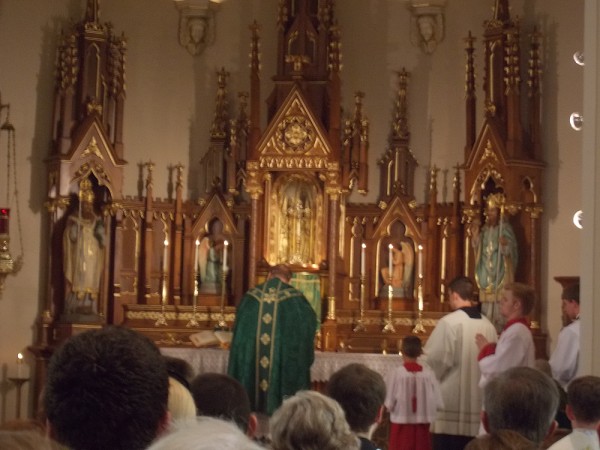 |
| Fr. Rick Heilman at the high altar of St. Mary's Pine Bluff, June 9, 2013 (photo: Elizabeth D/Lætificat Madison) |
Because Easter rarely falls as early as it did this year, the Mass celebrated was the rare 10th Sunday in Ordinary Time, Year C. All of the liturgical texts employed were of the day: there was no substitution of prayers, readings, or chants for others in the Missal, Lectionary, or Gradual that may have been considered appropriate or desirable. (As it turns out, every last assigned prayer, reading, and chant was quite appropriate for this Mass.) Everything was recited or sung in English unless indicated.
I should note that, other than the lack of an Entrance hymn, the addition of certain pieces at the Prelude and Communion, and the partially ad hoc choir, this is what currently passes for a typical Sunday Mass at Pine Bluff; the morning Mass for this day also featured choral singing from members of the parish choir.
St. Agnes to discontinue Orchestral/Sung Masses in EF, will only offer in Ordinary Form
Details at St. Agnes Bulletin10:00 a.m. OF Sung Latin High Mass in September
In an effort to respond to Pope Benedict’s Motu Proprio, Summorum Pontificum , and the requests of the faithful, Fr. Ubel began the practice of alternating the OF and EF Forms at the 10:00 a.m. Sung Mass. I commend him for his generosity and ingenuity. The Orchestral Masses and the Gregorian chant have served as unifying elements as we alternate from one Form to the other each Sunday; however, liturgical calendar issues still remain, as well as, whether or not this alternation is promoting the stability envisioned in Summorum Pontificum . As an example of the calendar difficulties, just two weeks ago we entered into the EF pre-Lenten time when we celebrated Sexagesima and then returned back to the 5th Sunday of Ordinary Time last Sun- day. In addition, many parishioners who desire the EF Mass find themselves alternating churches from week to week. Since Saint Augustine Church in South Saint Paul has been offering an EF Mass for quite some time in the later morning, it would seem prudent to offer an early morning Mass in order to offer the faithful another consistent opportunity and not to “compete” or conflict with other parishes.
I have had a couple of requests for the 10:00 a.m. Mass be celebrated only in the EF. That would be a great loss to Saint Agnes and the Local Church. Saint Agnes has literally been known throughout the world for the past four decades because of its Sung High Mass according to the Missal of Paul VI. Monsignor Schuler, with admirable knowledge and courage, carefully implemented the New Mass by obediently enacting the Council’s desire for the preservation of Latin, Chant and Sacred Music.
Therefore, starting September 15, 2013, the 10 a.m. Mass will return to being celebrated in Latin as a Sung Mass in the Ordinary Form with the only exceptions being Christmas and Easter. ( The Midnight Mass and the Easter Vigil Masses are already OF. )

I understand the concerns I guess, it would be hard to keep track week to week which form for which Sunday. The details state that there will now be a regular 7:30 am EF Mass now. I would take either form in the Schuler model if I could get it!
Well perhaps with time those singers with devotion to the EF could offer more complex settings for the 7:30 Mass as time goes on. .... I'd still say that for feast days that hopefully an EF can still be included.
Photo: The Catholic Spirit
St. John Cantius parish, Chicago, IL
I long have been impressed by the St. John Cantius parish website actually, an impressive and tasteful design, and also their videos at SanctaMissa.org. The parish is run by the Canons Regular of St. John Cantius, an order which basically started to staff and minister at this particular church.
Mass was Ascension Thursday in the Extraordinary Form. Confessions were heard during Mass with big lines. I did not get back to my seat until after the homily - which meant I failed to get a photo of the extinguishing of the Easter candle after the Gospel. That was very cool, too bad it got jettisoned. Mass was excellent, homily was good although I was in Confession for part. Confession was very good, thorough, not passing me off quickly, I prefer that since I'm not great at doing my own examine. Music was outstanding, I can't find what setting they were using now, I should have wrote it down. I really know little about real church music so I try to make notes as I go.
After Mass the Canons came out and chanted evening prayer(Ordinary Form in both Latin and English), it was magnificent, I got a couple cool pics of that as well. If I lived in Chicago, you better believe this would be my home parish.
Also, not my greatest attempt at photography, some turned out, some I'm not wearing a shoe on one foot, or drinking with blurred vision.


Mass was Ascension Thursday in the Extraordinary Form. Confessions were heard during Mass with big lines. I did not get back to my seat until after the homily - which meant I failed to get a photo of the extinguishing of the Easter candle after the Gospel. That was very cool, too bad it got jettisoned. Mass was excellent, homily was good although I was in Confession for part. Confession was very good, thorough, not passing me off quickly, I prefer that since I'm not great at doing my own examine. Music was outstanding, I can't find what setting they were using now, I should have wrote it down. I really know little about real church music so I try to make notes as I go.
After Mass the Canons came out and chanted evening prayer(Ordinary Form in both Latin and English), it was magnificent, I got a couple cool pics of that as well. If I lived in Chicago, you better believe this would be my home parish.
Also, not my greatest attempt at photography, some turned out, some I'm not wearing a shoe on one foot, or drinking with blurred vision.


Want to hear great church music? Head to the train station.
As a transplant from New York City who spent lots of time in the public transportation system (I commuted to high school from the suburbs for four years), I was astounded to discover this NYTimes story.
Here's the Wisconsin connection:
(HT Dcn. Kandra)
On a recent Sunday afternoon, 17 people with sheet music gathered in a semicircle in the Graybar Passage at Grand Central Terminal. People streamed by. After a brief warm-up, the group’s conductor, John Hetland, dressed in dark jeans and a green plaid shirt, lifted his hands and the chorus began its a cappella rendition of a polyphonic hymn, “Kyrie,” by the 15th-century German composer Heinrich Finck.I had never heard of this group until today; commuting to and from Long Island probably contributed to that. (Grand Central Terminal serves the suburbs north of Manhattan; and compared to GCT, NY Penn Station is positively ugly, both visually and acoustically.)
The hallway filled with sound, the baritones roiling like cumulonimbus clouds, the altos and sopranos shooting through like light, the melodies intertwining. The voices carried down the hall and were faintly audible in the Main Concourse. A crowd gathered to listen, but no one gave money, because there was nowhere to put it. When the song was over, Mr. Hetland turned around to face the small audience.
“We’re the Renaissance Street Singers,” he said, “singing the music that we love to sing and to share.”
Here's the Wisconsin connection:
Mr. Hetland, 71, has been singing choral music nearly all his life. His father, Henry Hetland, was a Lutheran campus minister at the University of Wisconsin-Madison (where students called him “Pastor Hank”) and, later, the executive secretary of the National Lutheran Campus Ministry in Oakland, Calif. In Wisconsin, he had directed a 50-voice choir, and he taught his four children to sing multipart hymns and folk songs to pass the time on long car rides. Soon, Mr. Hetland, his older sisters, Pauline and Maren, and his younger brother, Jim, were singing complex music as a treble quartet.Read more here.
(HT Dcn. Kandra)
But I grew up with hymns

For the record, I'm not against necessarily against hymns, just replacing the Mass with hymns.Let me put it this way. You're preferring what some dude or dudette wrote about God, to singing with God? Jesus, the Word of God sang the Psalms, the Word of God, not what some dude or dudette wrote about Jesus. And Jesus chanted these Psalms (chant is the musical vehicle for Judaism to this day). Y U NO WANNA CHANT W/JESUS?Liturgy is supposed to be an entrance into the life of the Trinitarian God. Not reduced to "I have reservations because I grew up with Liturgy being something entirely different."
Prayer to St. Michael performed in St. Peter's Basilica in Rome for Cdl. Burke
Performed by the St. Peter's Schola Cantorum in Rome at St. Peter's Basilica on January 4, 2012. Composed for and sung for Cardinal Raymond Burke. Composed by Peggy Clifford.
This choir has basically been disbanded after a priest transfer to the Stevens Point parish. The priest did not like sacred music and all efforts to quell his 1980s approach to liturgy fell on def ears. His antics lead to a mass exodus from the parish. Probably one of the best if not thee best parish in the La Crosse Diocese. Very sad, don't expect any protection in this diocese, it's every man for himself.
Free Polyphony in Pine Bluff: Holy Thursday
Other kinds of sacred music, especially polyphony, are by no means excluded from liturgical celebrations, so long as they accord with the spirit of the liturgical action. — Vatican II Constitution on the Sacred Liturgy Sacrosanctum Concilium ¶116
The all-volunteer choir at St. Mary of Pine Bluff is not numerous at the moment: at full strength we number about a dozen. Moreover, as many of the members are called in any number of directions as befitting their primary vocation to be in the world, rehearsals aren't always fully attended. (I'll probably have a blog post on handling such matters in the future.) However, the choir has been blessed with pretty good ears, at least one sight-reader on every part, and most importantly a recognition that it is the Lord we serve at the Sacred Liturgy and not ourselves.
Here are a couple of choral pieces we hope to debut on Holy Thursday. Below is a fresh setting of the first verse of the hymn Ubi caritas, which the Ordinary Form of the Roman Rite assigns to the Offertory.[1]
R/. Where true charity is dwelling, God is present there.
V/. By the love of Christ we have been brought together:
V/. let us find in him our gladness and our pleasure;
V/. may we love him and revere him, God the living,
V/. and in love respect each other with sincere hearts.
R/. Where true charity is dwelling, God is present there. Amen, amen.
The second piece is a Renaissance-era setting of the text assigned for Communion.[2]
This is the body that will be given up for you;
this is the chalice of the new covenant in my blood, says the Lord;
do this, whenever you receive it, in memory of me. — 1 Cor 11:24–25
The first composition mentioned in this post was created in 2012; the second in the mid–16th century. Yet they can and will successfully stand side-by-side not also with each other but also with liturgical plainsong compositions from 2010 and the earliest eras of the Church's history. And both of these compositions are freely available on the Internet in PDF form (thus the "free" in the title of this post):
Footnotes:
[1] The Extraordinary Form of the Roman Rite assigns this hymn to the Washing of Feet.
[2] The Extraordinary Form of the Roman Rite assigns this text to Passion Sunday/Fifth Sunday of Lent.
Benedict XVI and an Incarnational Theology of Liturgical Music
Carolyn Pirtle, Assistant Director of the Notre Dame Center for Liturgy, offers a useful encapsulation of Benedict XVI's approach to the issue of liturgical music. An extended excerpt is below, with my emphases in boldface. Here is the full article.
For the psalmist, offering sung praise to God implied singing with an understanding that surpasses mere rationality and transcends into the realm of sapientia, or wisdom, which “denotes an integration of the entire person who not only understands and is understandable from the perspective of pure thought, but with all the dimensions of his or her existence” (98). Ratzinger goes on to say that “there is an affinity between wisdom and music, since in it such an integration of humanness occurs and the entire person becomes a being in accordance with logos [with ‘reason’]” (98). It is in singing that the senses and the spirit are integrated into one being, and in singing to God that the being is incorporated into logos.
Christianity takes this understanding one step farther by understanding the Psalms not merely as hymns written by King David, but as hymns that “had risen from the heart of the real David, Christ” (97). Thus, singing “hymns of praise” not only harmonizes the senses with the spirit, but when Christians understand those hymns as having their source in Christ, they are also drawn out of themselves into harmony with the Logos, the Word-made-flesh, as they offer sung praise in and through Christ Himself. With this mindset, “Christ Himself becomes the choir director who teaches us the new song and gives the Church the tone and way in which she can praise God appropriately and blend into the heavenly liturgy” (97). In order to offer fitting praise, one must conform one’s song to that of Christ, “who did not regard equality with God as something to be grasped; rather, he emptied himself, taking the form of a slave” (Phil 2:6-7). [Read full article]
(HT: Adam Bartlett/ChantCafe.com)
"When people rightly call for a new dialogue between Church and culture today, they must not forget in the process that this dialogue must necessarily be bilateral. It cannot consist in the Church finally subjecting herself to modern culture… Just as the Church must expose herself to the problems of our age in a radically new way, so too must culture be questioned anew about its groundlessness and its ground, and in the process be opened to a painful cure, that is, to a new reconciliation with religion since it can get its lifeblood only from there. For this reason church music is really a very vital piece of a comprehensive task for our age which requires more than mere dialogue; it requires a process of rediscovering ourselves." —Joseph Ratzinger, A New Song to the Lord (1995), 95–6For Ratzinger, this process of “rediscovering ourselves” necessitates a setting aside of the current debate surrounding liturgical music and the discussions it has generated (scholarly and otherwise). Doing so will facilitate a return to “the original source” in exploring connection between faith and music as well as the role of music in worship: the Bible. In turning to the Psalms in particular, Ratzinger establishes a theology of liturgical music in one verse: “Sing hymns of praise” (Ps 47:8, NRSV). True to his roots as a theologian who takes the biblical narrative seriously, Ratzinger engages this text in Hebrew, Greek, and Latin in order to arrive at a richer translation. Suffice it to say that singing hymns of praise well entails more than making pleasant-sounding music.
For the psalmist, offering sung praise to God implied singing with an understanding that surpasses mere rationality and transcends into the realm of sapientia, or wisdom, which “denotes an integration of the entire person who not only understands and is understandable from the perspective of pure thought, but with all the dimensions of his or her existence” (98). Ratzinger goes on to say that “there is an affinity between wisdom and music, since in it such an integration of humanness occurs and the entire person becomes a being in accordance with logos [with ‘reason’]” (98). It is in singing that the senses and the spirit are integrated into one being, and in singing to God that the being is incorporated into logos.
Christianity takes this understanding one step farther by understanding the Psalms not merely as hymns written by King David, but as hymns that “had risen from the heart of the real David, Christ” (97). Thus, singing “hymns of praise” not only harmonizes the senses with the spirit, but when Christians understand those hymns as having their source in Christ, they are also drawn out of themselves into harmony with the Logos, the Word-made-flesh, as they offer sung praise in and through Christ Himself. With this mindset, “Christ Himself becomes the choir director who teaches us the new song and gives the Church the tone and way in which she can praise God appropriately and blend into the heavenly liturgy” (97). In order to offer fitting praise, one must conform one’s song to that of Christ, “who did not regard equality with God as something to be grasped; rather, he emptied himself, taking the form of a slave” (Phil 2:6-7). [Read full article]
(HT: Adam Bartlett/ChantCafe.com)
An Ordinary-Form Missa Cantata…almost
Given the events that are taking place in the Church these days, I doubt that this post will receive much attention; however, as restoration of liturgical beauty has been a hallmark of Pope Benedict's papacy, mentioning the local impact of his leadership seems noteworthy.
Last Saturday marked the third consecutive time that I was asked to lead the Knights of Divine Mercy schola cantorum at the closing Mass of the Diocese of Madison's Men's Lenten Retreat. This year's Mass (an anticipated Mass for the Second Sunday of Lent) was as close as it has been to the Missa Cantata, the Sung Mass so desired by the Church to be the norm in the Latin Rite but so exceptionally rare in practice, especially in the Ordinary Form.[1] The Mass, which was celebrated by Msgr. James Bartylla,[2] the Vicar General of the Diocese of Madison, was sung a cappella or said in English unless otherwise specified:
I think moving towards actually enacting what the Church asks in regard to the singing of the words of the Mass instead of relegating it to a printed book ought to be a primary objective, given the Year of Faith theme for our diocese: "Evangelization through Beauty".[5]
[1] "For the celebration of the Eucharist with the people, especially on Sundays and feast days, a form of sung Mass (Missa in cantu) is to be preferred as much as possible, even several times on the same day." Musicam Sacram Instruction on Music in the Liturgy, ¶27, emphasis added. Although some may argue that this instruction doesn't apply to the current revision of the English-language Roman Missal, in fact the 2010 revision provides almost all of the resources needed for the priest to sing: the parts of the Mass proper to himself; many of the parts he sings with the faithful, e.g., the Sanctus; and the parts of the Mass that are better delegated to others, e.g., lector.
[2] From September to May as his schedule allows, Msgr. Bartylla celebrates a Latin Missa Cantata with Gregorian chant and vernacular readings on the first Tuesday of each month at noon; he celebrates an English Missa Cantata with Gregorian-inspired English plainsong on the third Tuesday of the month at noon. In the case of a scheduling conflict these Masses are usually transferred to the following Tuesday. All of these Masses take in the chapel of the Bishop O'Connor Catholic Pastoral Center [map].
[3] Why this was ever called the "Opening Prayer" in the defunct English translation mystifies me. Does not prayer occur from the beginning of the Mass? It's more logical to understand the Collect as the closing prayer of the Introductory Rites.
[4] "Faith comes from hearing." Thus, I propose that during the Responsorial Psalm and other liturgical texts that share its nature, audible cues—such as slowing down at the final line of a verse and maintaining a consistent breathing pattern—are better than visual cues at fostering actual participation, i.e., intentional listening and prayerful singing. No visual cues were used to prompt the people's singing of the refrain other than psalmist's looking up from the ambo, which was done in conjunction with the aforementioned audible cues.
[5] A friend recently relayed to me a question asked of her by another friend regarding the difference between the High Mass and the Low Mass (within the context of the Extraordinary Form). I quipped: At High Mass, all the texts that are supposed to be uttered in song are sung. At Low Mass, all the texts that are supposed to be uttered in song are…muttered. There are other differences to be sure, but given the weight Church teaching has placed on sacred music, I focus on that primarily. And the musical differences between High Mass and Low Mass also apply to the Ordinary Form of the Roman Rite regardless of whether it is celebrated in its sacral languages.
Last Saturday marked the third consecutive time that I was asked to lead the Knights of Divine Mercy schola cantorum at the closing Mass of the Diocese of Madison's Men's Lenten Retreat. This year's Mass (an anticipated Mass for the Second Sunday of Lent) was as close as it has been to the Missa Cantata, the Sung Mass so desired by the Church to be the norm in the Latin Rite but so exceptionally rare in practice, especially in the Ordinary Form.[1] The Mass, which was celebrated by Msgr. James Bartylla,[2] the Vicar General of the Diocese of Madison, was sung a cappella or said in English unless otherwise specified:
- Introductory Rites
- Entrance Procession and Incensation of the Altar (Psalm 25: 6, 3, 22; 1–3; Glory Be; Simple English Propers, pp. 64–65): sung by the schola cantorum
- Sign of the Cross: Missal, solemn tone
- Greeting "Grace and peace…": Missal, solemn tone
- Penitential Act "Have mercy on us, O Lord…": Missal, solemn tone
- Kyrie: Mass XVI, Greek, sung by all
- Collect[3]: Missal, solemn tone
- Liturgy of the Word
- First Reading (Gen 15: 5–12, 17–18): Missal tone for the first reading, sung by a server/reader
- Responsorial Psalm (cf. Ps 27: 1a, Modal Responsorial Psalms, p. 39): sung by psalmist; response sung by all.[4]
- Second Reading (Phil 3: 17–4: 1): Missal tone for the second reading, sung by another server/reader
- Gospel Acclamation ("Praise to you, Lord Jesus Christ…", Modal Responsorial Psalms, p. 39): led by cantor; response sung by all
- Gospel (Lk 9: 28b–36): Missal, simple tone, sung by the Priest
- Homily: spoken (of course!)
- Creed: spoken (the Missal provides two melodies)
- Prayer of the Faithful: spoken (the Missal provides four melodic formulas)
- Liturgy of the Eucharist
- Preparation of the Offerings and Incensation (Psalm 119: 47, 48; Psalm 119; Simple English Propers, pp. 65–66): sung by the schola cantorum
- Invitation to Prayer "Pray, brethren, that my sacrifice": Missal, solemn tone
- Prayer over the Offerings: Missal, solemn tone
- Preface: Missal tone
- Sanctus: Mass XVIII, Latin, sung by all
- Eucharistic Prayer II: Missal tone
- Mystery of Faith "Save us, Savior of the world…": Missal tone
- Doxology: Missal, solemn tone
- Communion Rite
- Lord's Prayer: Missal tone for the Dioceses of the United States
- Embolism and Doxology: Missal tone
- Sign of Peace: Missal tone
- Agnus Dei: Mass XVIII, Latin, sung by all
- "Behold the Lamb of God" dialog: Missal tone
- Communion Chant I (Matthew 17:9; Psalm 45; Simple English Propers, pp. 66–67): sung by the schola cantorum; Latin Gregorian antiphon sung by a solo cantor
- Communion Chant II (John 6:51a; Psalm 23; English chant derived from the Latin original found in the Graduale Simplex): sung by a solo cantor
- Prayer after Communion: Missal, solemn tone
- Concluding Rites
- Blessing: Missal, solemn tone
- Dismissal "Go and announce…": Missal tone
- Hymn: "What Wondrous Love is This"
I think moving towards actually enacting what the Church asks in regard to the singing of the words of the Mass instead of relegating it to a printed book ought to be a primary objective, given the Year of Faith theme for our diocese: "Evangelization through Beauty".[5]
[1] "For the celebration of the Eucharist with the people, especially on Sundays and feast days, a form of sung Mass (Missa in cantu) is to be preferred as much as possible, even several times on the same day." Musicam Sacram Instruction on Music in the Liturgy, ¶27, emphasis added. Although some may argue that this instruction doesn't apply to the current revision of the English-language Roman Missal, in fact the 2010 revision provides almost all of the resources needed for the priest to sing: the parts of the Mass proper to himself; many of the parts he sings with the faithful, e.g., the Sanctus; and the parts of the Mass that are better delegated to others, e.g., lector.
[2] From September to May as his schedule allows, Msgr. Bartylla celebrates a Latin Missa Cantata with Gregorian chant and vernacular readings on the first Tuesday of each month at noon; he celebrates an English Missa Cantata with Gregorian-inspired English plainsong on the third Tuesday of the month at noon. In the case of a scheduling conflict these Masses are usually transferred to the following Tuesday. All of these Masses take in the chapel of the Bishop O'Connor Catholic Pastoral Center [map].
[3] Why this was ever called the "Opening Prayer" in the defunct English translation mystifies me. Does not prayer occur from the beginning of the Mass? It's more logical to understand the Collect as the closing prayer of the Introductory Rites.
[4] "Faith comes from hearing." Thus, I propose that during the Responsorial Psalm and other liturgical texts that share its nature, audible cues—such as slowing down at the final line of a verse and maintaining a consistent breathing pattern—are better than visual cues at fostering actual participation, i.e., intentional listening and prayerful singing. No visual cues were used to prompt the people's singing of the refrain other than psalmist's looking up from the ambo, which was done in conjunction with the aforementioned audible cues.
[5] A friend recently relayed to me a question asked of her by another friend regarding the difference between the High Mass and the Low Mass (within the context of the Extraordinary Form). I quipped: At High Mass, all the texts that are supposed to be uttered in song are sung. At Low Mass, all the texts that are supposed to be uttered in song are…muttered. There are other differences to be sure, but given the weight Church teaching has placed on sacred music, I focus on that primarily. And the musical differences between High Mass and Low Mass also apply to the Ordinary Form of the Roman Rite regardless of whether it is celebrated in its sacral languages.
A deacon on devotional and liturgical music
From a deacon at the Cathedral of the Madeleine in Salt Lake City:
My wife also enjoys listening to the local contemporary Christian radio station, and I appreciate the role that this music has played in her life of faith. But she has made no overtures to me about playing any of this repertoire in church, at Mass or otherwise. (Not that I have the final say in matters liturgical, anyway—that's the pastor's cross, ultimately.) Moreover, while we're listening in the car, she will point out theological errors in the lyrics whenever they occur.
Unlike many of my Catholic friends, I enjoy a fair amount of contemporary Christian music. My enjoyment of such music, by no means all of it, as much of is lamentably bad, has no liturgical implications, which means I have no desire for it to comprise any part of the Sacred Liturgy. But for devotional purposes, I find some of it wonderfully suitable in that way only music can be. (more)The Cathedral of the Madeleine happens to be the home of one of two Catholic elementary choir schools in the United States (here's the other), so it's safe to say that he has a fuller understanding of what constitutes liturgical music via lived experience.
My wife also enjoys listening to the local contemporary Christian radio station, and I appreciate the role that this music has played in her life of faith. But she has made no overtures to me about playing any of this repertoire in church, at Mass or otherwise. (Not that I have the final say in matters liturgical, anyway—that's the pastor's cross, ultimately.) Moreover, while we're listening in the car, she will point out theological errors in the lyrics whenever they occur.
Subscribe to:
Posts (Atom)