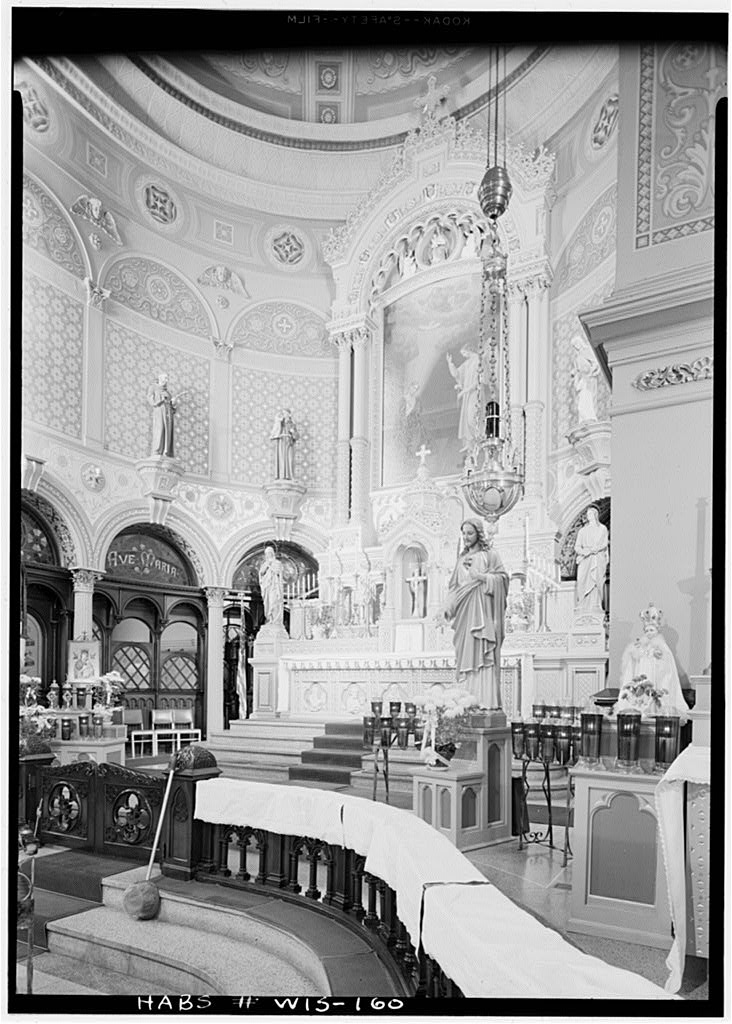
The National Shrine to Saint Philomena is a landmark in Briggsville, located on the east side of Mason Lake in Marquette County. The shrine was dedicated in 1949 and was planned as a replica of the dungeon where the young Martyr-Saint, Philomena, had suffered and died to preserve her virginity.
Assistant Engineer Billy Hamilton of the 'Fanny Harris'
Merrick described Billy Hamilton, the assistant engineer on the Fanny Harris, as "a wild one on shore and a terror to the captain when on board and on duty." His commanding officer was particularly annoyed by Hamilton's habit of burning massive amounts of fuel and running his boilers at dangerously high pressure.
But whenever the captain had a dispute with the unruly crew -- which Merrick described as "composed of 40 Irishmen" -- Hamilton assisted by "jumping into a crowd and hitting every head in sight with whatever weapon happened to be at hand until order was restored.Usually, however, it was with bare hands..."
His Prank and Its Consequences
One spring while the steamboat was still iced-bound at Prescott, Hamilton decided to play a prank on the crew.
"The night before St. Patrick's Day," the old pilot recalled, "Billy made up an effigy, which he hung between the smokestacks. As the manikin had a clay pipe in its mouth and a string of potatoes about its neck, it might have reference to the patron saint of the Old Sod."
It was an era when Irish immigrants were greeted by prejudice or even violence, and the crew was not amused. Nor were the loyal Irishmen of the town. "Billy had to stand off the crowd for several hours with a shot gun, and finally get the town marshal to guard the boat while he climbed up and removed the obnoxious image."
Prescott's residents sought retaliation with a prank of their own. Hamilton "had a little iron cannon which he fired on all holidays," Merrick continued, "and sometimes when there was no holiday; in the latter case, at about three o'clock in the morning, just to remind people living in the vicinity of the levee that he was still on watch. In retaliation for the effigy affair, his Irish friends slipped aboard the boat one evening while he was away and spiked his cannon."
"We purchased a Latin Mass missal at my grandparents estate sale recently. Inside I found this Bulletin from St. Patrick's Church in Madison, WI - February 7th, 1965.
"This was before the Novus Ordo (New Mass) came out. It is interesting to note the number of daily and Sunday Masses compared to today. Some of the comments on the bulletin also seem to be quite the zingers seeing as the new Mass was not out yet."
You can click the image to make it larger.
Remember the poem at the end was prior to the Novus Ordo being published in 1969, but I'm not sure how that makes sense considering the content. Ahh, Aristotle has educated me that there was a 1965 Transitional Missal, I was not aware.
Latin's gone Peace is too Singin', an dshoutin' From every pew. Altar's turned around Priest is too Commentator's yellin' Page twenty two. Communion rails goin' Stand up straight Kneelin' suddenly Went outa date. Processions are formin' In every aisle Salvation organized Single file. Rosary out Psalms are in Hardly ever hear A word against sin. Listen to the Lector Hear how he reads Please stop rattlin' Them rosary beads. Padre's lookin puzzled Doesn't know his part Used to know the whole deal In Latin by heart. I hope all changes Are just about done That they don't drop Bingo Before I've won.
Haha, great finish!
Could you imagine if something like this went in a bulletin today?
Demolition of the Catholic Diocese of Green Bay chancery in 2010
Members of the City Council Protection & Welfare Committee recently agreed to send the proposal back to city staff for potential changes, including possibly adding an appeal process for property owners whose buildings are ruled historic.
Nearly half of the buildings in Green Bay are 50 years old or older.
Historic preservation advocates have been pushing for greater protection of historic structures in recent years, especially after the Catholic Diocese of Green Bay in 2010 knocked down a nearly 100-year-old chancery in Allouez despite community pleas to save it.
Green Bay issues about 50 demolition permits annually — or about one every week.Members of the city’s Historic Preservation Commission, who have faced resistance to designating more buildings as local landmarks, say they have been disappointed to see valuable structures bulldozed, often without advanced notice.
Maybe I missed this but Patheos has a Catholic historical blog by Pat McNamara.
Katzer, Frederick Xavier, third Roman Catholic Bishop of the Diocese of Green Bay and first Archbishop of Milwaukee, was born at Ebensee, Austria, Feb. 7, 1844, son of Charles and Barbara (Reinhartsgruber) Katzer. After attending school at Gruündin, Austria, to which place his parents had removed, he began his classical studies in 1857 at the Jesuit College, Linz, Austria. He was graduated there in 1864, and coming to America in May of the same year, studied theology at the Seminary of St. Francis de Sales, near Milwaukee, Wis., where he completed his studies and was ordained a priest, Dec. 21, 1866.
So to follow up on Virginia's Clown Mass post from yesterday, Steve Kuhl sends me an email with this follow up article and says only "It was pretty bad back then." I can't even imagine.
Petition supports clown priests
A petition is being circulated in support of a Roman Catholic priest who conducted a controversial clown mass for children at a church.
Parish member Mary Ellen Nelson said she started circulating the petition in support of the Rev. Edward Hussli in response to a petition started by another parish member, Pat Lindmark, critical of the clown mass at St. Agnes Roman Catholic Church.
Literature was distributed prior to the Feb. 2 mass during Catholic Education Week telling children at the parish school and their parents that, although the clown may appear foolish, his foolishness was an attempt to direct people to higher truths.
Huselli has declined comment, but he said in a letter to one of his critics, "We are trying to save this generation of kids for the church and anything we can do with the liturgy to make it more meaningful and understandable for our kids we will do!"
The wonder of St. Norbert Abbey can be seen in its stately architecture and colorful stained glass.
The images often evoke awe in people of all ages, including 2-year-old Austin Beauchamp, grandson of Judy Turba, public relations coordinator of the Abbey.
"When he came into the church for the first time," said Turba, "his eyes got bigger and bigger, and all he said was, 'Oh. Oh, oh, oh. Oh!'"
Even in his youth, Austin recognized the magnificence of the Abbey within its 160-acre grounds. This unique setting is the inspiration for the six-part educational "Spotlight Tours" on the Abbey's architecture, symbolism and visionaries led by the Rev. Stephen Rossey, O. Praem., artist and historian.The initial presentation, "Unfinished Symphony: Spotlight on Architecture," will focus on the unique structure and style of the premises.
The new abbey dedicated in 1959 (before Vatican II mind you) We've seen that the 1950s was a decade of devastation in this state for beauty in churches.
My next stop in Milwaukee was at St. Joseph's Chapel which is run by the School Sisters of St Francis. I contacted them prior to the trip and they told me that they were setting up for a concert and no tours were available but that the chapel would be open and we would be free to go in for a look. When we arrived the receptionist gave us the third degree, but then a sister(I assume) came out and asked us what I was going to use the pictures for. I told her I was going to make postcards to sell to put my kids through college(joking). She did end up letting us go in. Only a few of the lights were on and some of the concert equipment was setup so I didn't get the best photos.
The chapel was beautiful, and probably the most striking thing are the relics on display. Several reliquaries are spread throughout. It is much like the Mary, Queen of Angels chapel in La Crosse, run by the FSPA. The FSPA's is I think more beautiful, but this chapel doesn't suffer from the 1970's red carpet that the former does. Also I was not thrown out and forbidden to return by the Sisters here, so that was an added bonus. There is also an adoration chapel on the other side of the sanctuary, but we did not go around to see it(we weren't sure even where to go). I heard later after we left that the Archdiocesan offices are now located there? I thought they were at the Cousins Center but I forgot about the whole trying to sell it thing. At any rate, besides the somewhat strange ufo lighting, a beautiful chapel. I wonder what kind of concert they were having?
History - Built 1846-1847, rebuilt 1866, most important of several interior renovations in 1893. Except for a small wooden chapel, this is the oldest church in Milwaukee.
Architectural character: Classically inspired composition with lofty bell-tower and details (heavy projecting pediments etc.) strongly suggestive of German inspiration.
Architect: The architect for the original building is unknown. However, Victor Schulte who v/as the architect for the 1866 rebuilding of the church may also have been the architect for the original building.
I could not find any current pictures to compare against, but they do have a parish website. So why it is called "Old"? Is there a new St. Marys? Has any of the interior survived?
As beautiful as Gothic churches can be, I find a church like this (round = "classical"?) more appealing.
Jesus Christ, yesterday, and today; and the same for ever. Hebrews 13:8. I found this amazing photo in an antique store. On the back the writing says...Father Vincent F. Hart, Freeglatz Yard, Mainz, Germany July 8, 1945.
There's no dates or further information. I would think these were probably pulled from some other repository of photos and slapped in this website. Not sure of their origin.
Even the difference between Wisconsin and Minnesota is noticeable. The bars there don't even sell their own states beer like Summit and Schell's. The personal connection that should exist in business has been replaced by the highest bidder.
I've noticed some former taverns turn their operation into primarily a restaurant with a bar to overcome that perception that there is something dirty and bad about a tavern. Don't get me wrong, there are some nasty places out there, with their porno gambling machines and whatnot. But there are plenty of family owned businesses which act as the local watering hole that is cultivating a community. Can anyone else identify with going to the bar when they were kids?
The problem with the modern man is that he thinks there is a disconnect from drinking and family. Look at the drunks in college now. They never learned what enjoying a beer was when they were growing up. The bar was "bad" and now because they find themselves in a bar they are being "bad" so they might as well be as "bad" as they feel inclined to.
To you out of state readers, St. Raphael's was burnt down(arson) in 2005 by this guy. Father Z posted a nice photo of a painting depicting firefighters in the Cathedral wreckage.
I think even when a church needs additional space in the sanctuary, that there is no need to throw out the baby with the bath water. It's like there was this effort to make sure that no church would ever again look like those old outdated ethnic parishes. I would have loved to see someone adapt the ethnic parish look and feel but be innovative enough to extend it's look to meet the modern need. I mean, what's with the UFO lights? I feel like the La Crosse Cathedral had a similar situation. We needed to extend the space and did make a grand, large church, but lost something in the translation.
An Indiana man is painting new life into a quiet hallway at Holy Hill.
Scott Dercks, of Fort Wayne, recalls visiting the National Shrine of Mary Basilica with his father when he was 8 or 9 years old. Murals along the wall on either side of the second floor walkway are labeled with a litany to Mary - "Queen of Angels," "Mother of the Savior," "Queen of All Saints."
"I always wondered what the symbols meant," said Dercks, who is originally from Muskego.
That curiosity stayed with him during his studies at Indiana Wesleyan University, when he received his master's degree at the University of St. Francis in Forty Wayne and as an art teacher at Northrop High School.
While visiting the area last year, he was surprised to see the level of decay the murals had fallen into.
"They were in such disrepair - stains, mold, cracks. I felt called to do something about it," said Dercks.
He wrote the Discalced Carmelite Friars to ask permission to refurbish the paintings. Included in his letter were photos of the set design he had done in college and for the school's theater department. After a few months, the friars agreed to his request.
"We continue to be inspired by the faith of the men and women who help maintain the Shrine. Scott's work will be seen and appreciated by the many pilgrims who travel here seeking God and the intercession of Mary, Help of Christians at this beautiful Basilica," said Holy Hill Prior the Rev. Jude Peters.
Dercks received a grant from the Lilly Endowment that covers his travel and art expenses and the work is being done at no cost to the shrine.
He is currently living in the guest house at the shrine.
"It's a simple room and it gives me time to paint, pray and contemplate," says Dercks.
On July 15, he was working to complete the overhead mural that reads "Holy Trinity - One God" in the Marian Hallway.
He said traditionally, the three linked rings symbolize the Holy Trinity, but he also sees it as a link between God, himself and others.
He said it is one thing to view each symbol independently, but another to see them as a whole message.
Taken together under a rainbow depicted on the overarching wall, Dercks sees it to mean that we are all very different, but all loved by God.
Dercks said a painted eye inside a triangle, similar to one found on the back of currency, symbolize the watchful eye of God.
"It keeps us honorable, keeps us watchful and keeps us in the presence that our way is not always God's way," said Dercks.
Perhaps his favorite is the symbol of the Holy Spirit and the seven gifts, which Dercks interprets as a symbol of peace.
"Peace is so important, especially in our modern times. In modern day society, we don't seek peace as often as we should. Peace is a powerful gift," said Dercks.
He also finds that peaceful spirit inhabits the Marian Hallway.
"It wants you to be quiet. You want to observe it and fell it," said Dercks.
After completing restoration on the main mural, Dercks plans on cleaning, patching and sealing the Marian litanies.
"Somebody put a lot of love in these murals. They should be around for another generation," said Dercks.
The Rev. Cyril Guise said the original paintings were done about 45 years ago by Brother Francis Enders. He said the Marian Hallway also contains historical artifacts from the shrine, including a model of the first church on the site and a reproduction of the first wooden cross that marked the glacial hill in 1674.
Dercks said considering the murals were done in tempera paint nearly five decased ago he is surprised the murals are still around. The hall is open to the elements on one end.